
THE ASV BLOG
— by JANICE NINAN

ARCHITECTURE BEFORE ARCHITECTURE
Story Sundays | The stone building that raised ME…
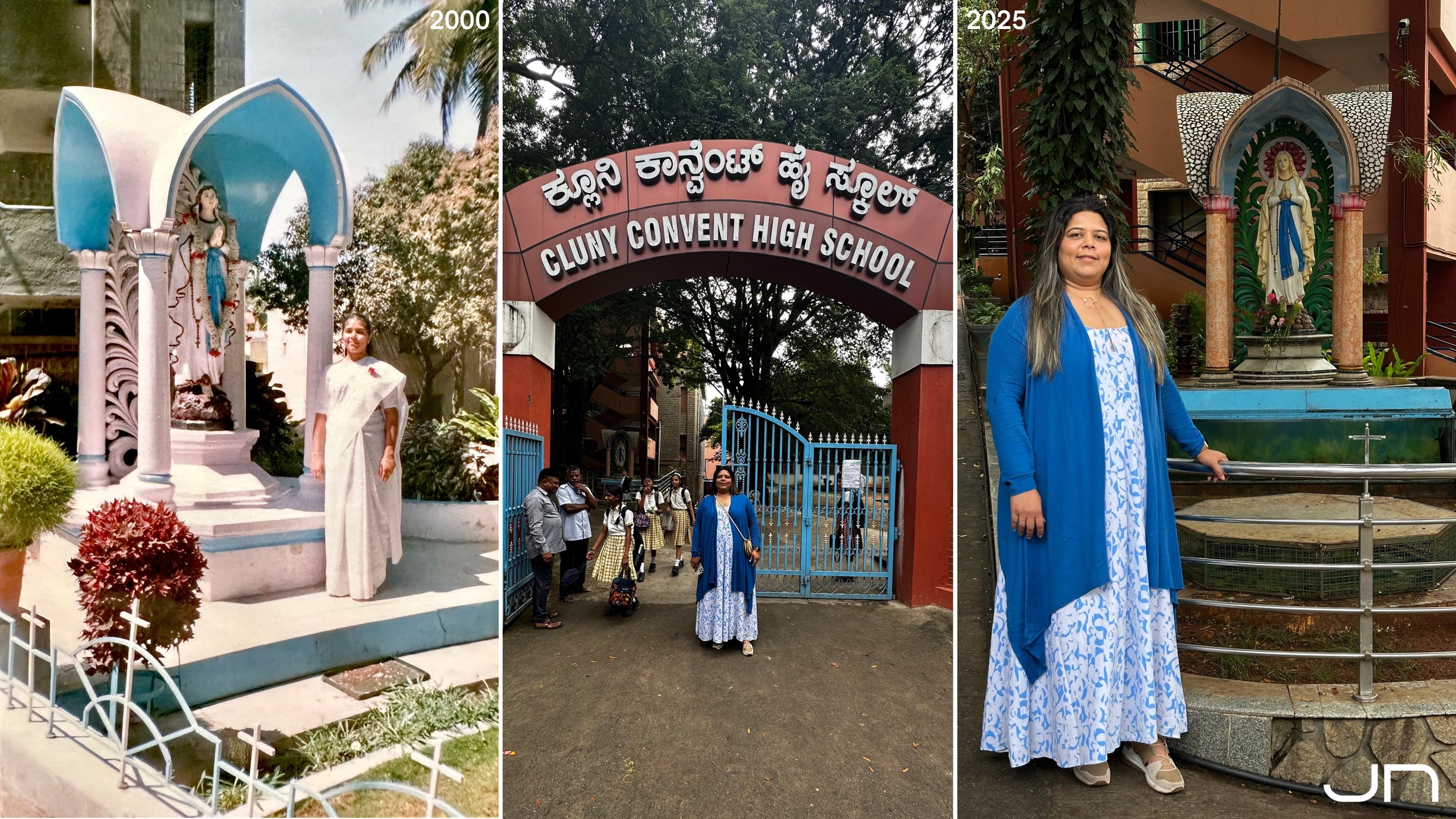
In 2025, I realized something quietly astonishing: it had been twenty-five years since I graduated 10th grade.
I belonged to the millennial batch of 2000, the cohort that stepped into the new millennium from the gates of St. Joseph’s Cluny Convent Girls’ School, Malleswaram, Bangalore—certain that life was just beginning, unaware of how profoundly those gates had already shaped us.
In September 2025, I returned.
I stood once again before the gates of the school that held me from kindergarten through 10th grade. Twelve years of mornings that began too early, afternoons that ended too late, and years of growing slowly—and then all at once.
The moment I stepped inside, time softened, folding decades of memory over the present—a palimpsest of the girl I had been, and the woman I had become.
Palimpsest | Layers of Memory
Cycling to school, the weight of my bag balanced against the rhythm of pedaling, I remembered the tamarind tree at the entrance, its pods scattered beneath, sticky and sour-sweet in our fingers. We would gather beneath it, cracking the fruit, savoring the fleeting rebellion before the bell rang.
Mornings were a ritual: early assemblies, the air still cool, voices rising together in synchrony. Once a week, march pasts measured our steps, teaching unity long before we understood the lesson.
As we made our way from the assembly to our classrooms in the three-storey stone building, a teacher’s voice would rise above the chatter:
“Heads up! Shoulders back! Walk like ladies!”
At the same time, house captains patrolled the staircases, calling out:
“Hands off the banisters!”
Uniforms inspected, collars straight, skirts tucked, buttons accounted for, shoes polished, hair tied, nails clean—no short skirts above the knee, no jewelry, no rolled up socks, no nail polish, no fancy ribbons or hairstyles, no exceptions. Discipline was inscribed into our bodies as indelibly as the grooves in the stone steps we climbed.
During breaks I would linger past the music room, drawn to the notes a friend played on the piano. I never took lessons myself till later in life—but I learned to listen, to let music fill a hallway, and to carry its echo long after the final note faded.
Evenings were no less regimented. Sports practice—volleyball, throwball, javelin, discus, shot put—taught strength, focus, and release. Later, karate, sweat and repetition, earned me a black belt, first dan. Then my sister and I would cycle home, tired, exhilarated, the sky soft with fading light, laughter trailing behind us.
Reverie | Lingering in Time
The three-storey stone building still stands—dignified, quiet, unchanged in spirit. As a child, I did not have words for why it mattered. As an architect, I now understand. That building held us. It taught rhythm, patience, and order. It absorbed our voices and returned them as echoes.
Standing before the chapel and St. Mary’s statue, camera in hand, I photographed not just the structure, but the feeling it carried—the thresholds crossed unconsciously, the small rituals that shaped a lifetime.
New wings and modern additions surround the old stone, necessary, perhaps, but quieter in soul. They do not speak the same language as the original. And yet, the heart of the campus, layered in memory, remains intact.
Continuum | Life in Motion
Returning after twenty-five years was not about longing. It was about honoring.
Before architecture school. Before theory. Before vocabulary.
There was movement, discipline, sound, and stone. There were rituals that shaped me, thresholds that guided me, and echoes that lingered across time.
As I walked out of the gates again—once in 2000, and again in 2025—I felt gratitude rise quietly. For the girl I once was. For the rhythms that formed her. For the place that raised me, patiently and completely.
Some buildings do more than house memories.
They become them, stitched into the continuum of our lives.
GOODBYE 2025 | WELCOME 2026
As the final blog of 2025, I pause here with gratitude—and curiosity. I look forward to 2026, to the stories that will unfold as I delve into memories, bringing them back to life with photographs, reflections, and the architecture of the everyday.
Happy New Year!

PRESERVED IN PROGRESS
WIP Wednesday | The Cathedral that never stops being Built — Preservation Lessons from Cologne’s Kölner Dom.
Some works in progress last a day. Some last a season.
And then there are works in progress that stretch across centuries — becoming living testaments to endurance, craft, and care.
Few buildings embody this better than the Kölner Dom in Cologne, Germany: a Gothic masterpiece that survived the bombings of World War II, outlasted six centuries of construction stops and starts, and continues to be preserved stone by stone even today.
After the war, restoration teams faced a monumental question:
How do you repair a building that took 600 years to build?
The answer became a multi-decade—and now ongoing—project:
shattered tracery rebuilt
stone vaults stitched and anchored
stained glass painstakingly reassembled or redesigned
cracked piers reinforced internally
roofs reconstructed from charred fragments
I knew all of this intellectually before I visited — the Gothic engineering, the war damage, the perpetual restoration — but nothing prepared me for the experience of walking it, touching it, and ascending into its voice.
This is not just a building.
It is a living architectural being — a work in progress that has never stopped evolving, watching, remembering, and speaking.
Walk around the exterior today and you can see the cathedral’s physical memory: areas of lighter, younger sandstone inserted beside centuries-old, soot-darkened originals. Every color shift represents a moment in its repair story.
Architecture as Witness and Memory Keeper
The cathedral’s survival became a symbol of resilience for post-war Germany. Photographs from 1945 show the spires rising above a flattened city — a reminder of endurance when everything else felt lost.
The building is not just architecture.
It is witness.
It is memory.
It is a record of what humanity chooses to preserve, even after destruction.
A STONE Giant That Refused to Fall
Cologne was one of the most heavily bombed cities of WWII. More than 90% of the inner city was destroyed. Yet the cathedral — hit by fourteen bombs, pierced by shrapnel, shaken by shockwaves — remained standing.
Its survival was not luck.
Its survival was design.
The pointed arches, ribbed vaults, flying buttresses, and thick piers formed a skeletal system so resilient that even modern warfare could not collapse it. When the city was flattened around it, the spires rose defiantly above the rubble.
The architecture spoke the only words possible in such devastation:
I am still here.
My experience began in the plaza — a vast stone forecourt alive with thousands of people moving, pausing, circling, meeting, admiring. The cathedral dominates this space not just visually but energetically. Every step feels like entering a gravitational field.
The rhythmic bustle of the crowd contrasts with the stillness of the façade, a stone tapestry stretching impossibly high. The steps leading to the main portal are worn by centuries of feet — pilgrims, tourists, worshippers, students, the curious, the hurried, the lost.
Architecture speaks here through scale, presence, and human movement around it.
Standing at the base of the façade, I felt small in the best possible way — grounded, humbled, welcomed into a story larger than myself.
Inside the Nave — Darkness, Light, and Vertical Silence
Stepping inside, the cathedral’s interior felt like entering a different atmosphere. Cool stone. Soft shadows. Light filtering through stained glass like diffused whispers in color.
But the moment that changed everything wasn’t at floor level.
It was above.
Climbing the Spire — Architecture as Physical Experience
The ascent to the top of the spire is not glamorous. It is physical, narrow, steep, and deliciously disorienting. The spiral staircase coils upward like the inside of a shell. The walls thicken. The air cools. The sound of the plaza fades until there is only breath and stone.
Architecture speaks here through compression — a lesson in how movement shapes emotion.
Reaching the open-air walkways encased in steel mesh felt like stepping into the cathedral’s lungs. Wind rushed through the openings. The city appeared below me in fragments. The stonework — tracery, gargoyles, moldings — revealed itself up close with a level of detail that the plaza could never show.
This is where I truly understood the building as a living organism, perpetually repaired, cleaned, monitored, and honored by the team at the Dombauhütte.
Every lighter stone is a sentence added later.
Every darker stone is an older part of the story.
The Bell Tower — Where Architecture Vibrates
And then came THE BELL!
Seeing the largest bell — St. Peter’s Bell, one of the world’s biggest free-swinging bells — is breathtaking. But hearing it? Feeling the vibration move through the metal grate beneath my feet, through the walls, through my ribs?
That was architectural sound.
Not metaphor.
Not poetic imagery.
Actual sound.
Stone translating vibration into feeling.
Architecture speaking literally.
Looking Down Into the Cathedral
One of the most surreal moments was standing above the nave, looking down into the interior from high above. From this vantage, the ribbed vaults presented themselves like an intricate stone web. People on the ground appeared like moving points of color.
This perspective rewired my understanding of Gothic ambition.
It’s one thing to admire the vaults from below.
It’s entirely another to see how they lock together from above — structure, geometry, light, gravity, all held in exquisite tension.
Preservation as a 700-Year-Long Conversation
Kölner Dom is arguably one of the most continuously maintained structures in Europe. Constantly monitored. Constantly renewed. Its sandstone erodes quickly, turning conservation into a full-time calling.
Its governing body, the Dombauhütte—a medieval-style workshop dedicated solely to the cathedral—still operates today. Stonemasons, glaziers, structural engineers, art historians, and scaffolding specialists work every day — literally every single day — to keep the building alive.
This is where the philosophy crystallizes:
Architecture that speaks volumes cannot ever be “finished.”
Its voice is shaped by:
war scars
pollution stains
newly cut stones
medieval carving traditions
contemporary engineering
weathering
human hands
time
The building evolves, and that evolution becomes its message.
What the Kölner Dom Taught Me About How Architecture Speaks
Walking the plaza…
Climbing the stairs…
Standing beside the bells…
Looking down into the nave…
Watching sunlight move across stone…
All of it converged into a single lesson:
Architecture speaks through endurance, presence, and lived experience.
It is not frozen.
It is not silent.
It is actively communicating — if we take the time to listen.
The Kölner Dom speaks volumes about:
resilience
craftsmanship
continuity
memory
community
faith (in both the spiritual and architectural sense)
the long arc of human effort
And most importantly:
that some works in progress are meant to last forever.
A Final Thought: The Cathedral as a Living Conversation
As I descended back to the plaza, reentering the movement of the crowds, I realized something profound:
Every person who touches this cathedral becomes part of its ongoing story.
Every stone replaced continues the dialogue.
Every footstep on the plaza acknowledges its presence.
Every preservation effort is an act of care, not completion.
The Kölner Dom does not ask to be admired.
It asks to be understood.
And through its walls, its scars, its bells, its views, and its never-ending restoration, it reminds us — especially those of us who design — that architecture speaks volumes when it is allowed to live, adapt, and endure.
Why This Matters for Designers Today
In our contemporary world of fast timelines and faster demolitions, Kölner Dom challenges us to rethink what “preservation” means:
What does it look like to design for centuries, not decades?
How do we plan materials that can be repaired, replaced, and honored over time?
What does stewardship mean in an era obsessed with speed?
How do we let a building age authentically, while protecting it from irreversible loss?
Preservation isn’t about freezing a building in time.
It’s about allowing it to change—carefully, deliberately, respectfully.
Kölner Dom is a masterclass in this mindset.
A reminder that architecture isn’t a final product.
It’s a relationship.
And some relationships are meant to last forever.