
THE ASV BLOG
— by JANICE NINAN

OPEN HOUSE CHICAGO
Story Sundays | From Volunteer to Participant in Chicago’s Architectural Story
Every October since 2011, Chicago has offered the world a free backstage pass to experience the architecture that shapes its skyline and urban fabric. For one weekend, Open House Chicago transforms the city into a vast stage of discovery, opening the doors of buildings and spaces rarely accessible to the public. It’s an invitation to see the city not just as residents or tourists, but as explorers.
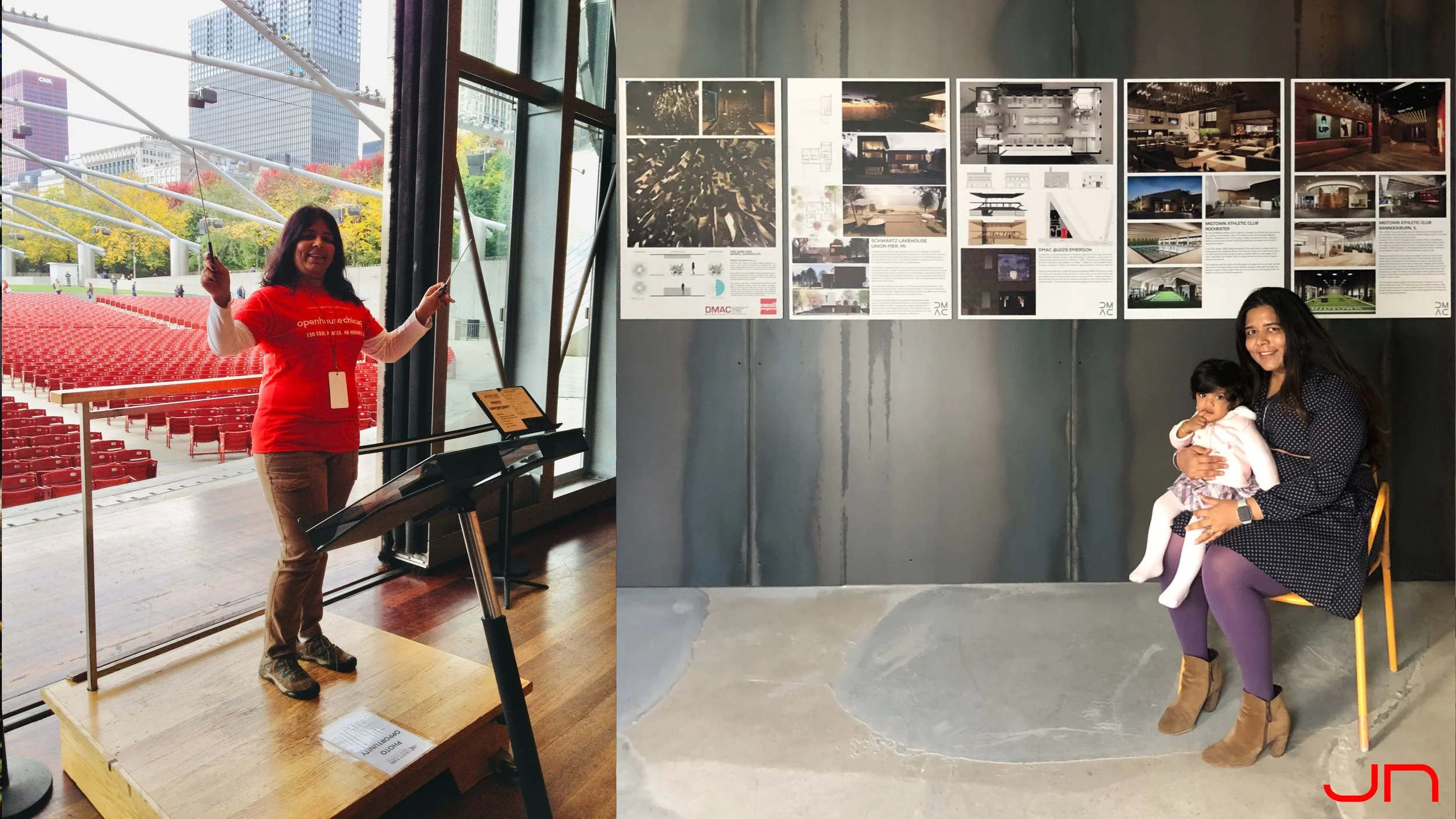
For me, Open House Chicago has always been more than an event — it has been a thread woven into my own architectural journey. I began as a volunteer nearly 15 years ago, and later returned as a participant while working at DMAC Architecture and Interiors, sharing my designs and perspectives with fellow enthusiasts.
My First Open House: The Tribune Tower
My very first assignment as a volunteer was at the Tribune Tower, the neo-Gothic landmark completed in 1925. On the exterior, I marveled at fragments of historic structures embedded into its façade — a tradition begun by publisher Colonel Robert R. McCormick that continues to fascinate visitors.
Inside, the experience unfolded like a private tour through Chicago’s architectural memory. In the lobby, inscriptions celebrated the “free press.” In the cavernous press room, grooves carved into the floor marked where massive rolls of paper once fed the Tribune’s presses.
From there we rode the elevator to the 24th floor, where the conversation among my fellow passengers drifted to Pulitzer Prize–winning critic Blair Kamin. At the top, we entered the Tribune boardroom — once called the Colonel’s Quarter — the executive suite of McCormick and his co-publisher Joseph M. Patterson.
Then came the revelation. Behind a paneled wall, a hidden door revealed a narrow wooden staircase. On the blueprints, it was disguised as a “file room.” Known as the “escape tower,” the secret passage was designed for McCormick, who feared an angry mob might one day storm the building. Whether paranoia or prudence, the eccentricity of it stayed with me.
That first glimpse behind the curtain taught me that architecture is never just form and function — it is also personality, eccentricity, and myth. It shaped the way I have experienced Open House Chicago ever since: with curiosity about the stories buildings hold.
A year later, I had another unforgettable moment at the Tribune Tower, standing on the open-air observatory on the 25th floor during an AIA event. From beneath its soaring flying buttresses, the views of the Chicago River and the Loop were nothing short of surreal.
The Tribune left the tower in 2018, and the building has since been transformed into luxury residences, earning a 2023 Driehaus Prize for preservation and adaptive reuse from Landmarks Illinois.
Volunteering: Witnessing Curiosity Firsthand
As a volunteer, I stood at thresholds, welcoming visitors into spaces of history and innovation. I watched as they entered with wide eyes, connecting what they saw to their own lives, memories, and imaginations. Through their questions and reactions, I learned something invaluable: architecture lives beyond its walls. It becomes complete through the stories people carry into it.
Participating: Joining the Dialogue
Later, with DMAC Architecture and Interiors, I returned not as a volunteer, but as a participant. Sharing my work was not simply about displaying drawings — it was about entering a dialogue. Visitors asked about my process, my inspirations, the meaning behind the designs. In those conversations, my role shifted: I was no longer only a guide, but a storyteller — one voice among many in the collective conversation Open House Chicago fosters .
The Gift of Participation
Over the years the participation has grown, drawing visitors from across the globe. I still remember welcoming a group of 67 guests from France - all eager to experience the city’s architecture firsthand!
Moments like these remind me that architecture is never solitary. It thrives on participation — on people being curious, engaging, questioning, and responding. Open House Chicago embodies that principle: it dissolves the boundary between architect and audience, insider and outsider, designer and explorer.
Looking Ahead: Open House Chicago 2025
This year’s Open House Chicago takes place October 18–19, 2025, with more than 200 sites opening across the city and surrounding neighborhoods. Last year, the festival launched a photography competition with four categories — Interior, Exterior, Detail, and Black & White. This year, a fifth has been added: People & Buildings, a fitting way to capture the event’s spirit through the eyes of its visitors.
An Invitation
From volunteer to participant, my journey with Open House Chicago continues to shape how I see the city and how I practice architecture. It is a reminder that architecture speaks volumes when it becomes a shared story.
If you’re in Chicago next weekend, I encourage you to take part — wander, explore, and maybe even bring your camera.
Open House Chicago is more than an event; it’s a conversation. One that we’re all invited to join.
📖 Read more stories on Architecture Speaks Volumes Blog THE ASV BLOG
📸 Join me on Instagram @architecturespeaksvolumes
Skylines in Motion
Story Sundays | When the City joins the Show
The first time I photographed the Chicago Air & Water Show from North Avenue Beach, I didn’t just watch the planes — I watched the city respond.
It was August 2011. The day was bright, already warm when I woke up. I dressed quickly, slung my Nikon D700 over my shoulder, and began packing my camera bag: extra lenses, lens hoods, memory cards, sunscreen and just enough water and snacks to last the day.
Outside, the city felt charged. I caught the CTA bus, then the train, then another bus, watching Chicago’s steel and glass slide by in the windows. The closer I got to the lake, the more the streets swelled with people — sunglasses on, folding chairs in hand, beach bags slung over shoulders. Everyone seemed to be moving in the same current.
After stepping off at North Avenue, I crossed the pedestrian bridge over Lake Shore Drive. The blue sweep of Lake Michigan opened before me — glittering under the late-summer sun. The hum of the crowd mingled with the first distant rumble of jet engines. On the sand, I moved slowly, weaving between sunbathers and swimmers, searching for a clear spot — somewhere my gear would stay dry and my sight-lines would stay wide.
The sand was hot, the lake sparkling, and the air thick with anticipation. I found myself a spot on the boardwalk where photographers- both professional and novice had already staked claim on prime positions for an uninterrupted view. From here, the city was not just the backdrop — it was a participant.
Rooftops and terraces had transformed into grandstands, their railings lined with leaning bodies, the skyline itself alive with spectators. Out on the water, boats clustered together, their bows facing back toward the shore. The anticipation was a tangible thing.
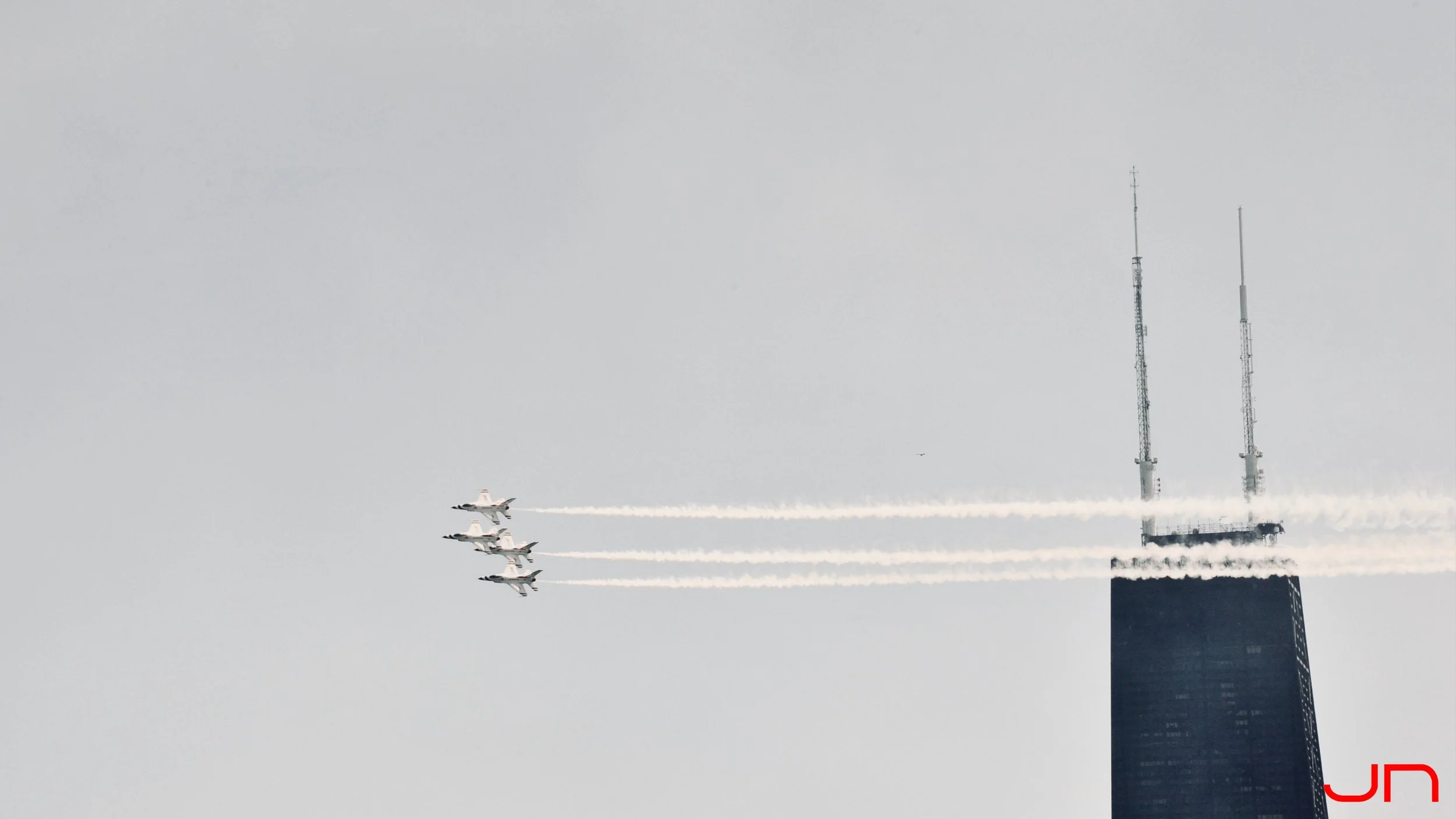
Then — the roar. Somewhere behind me, a child squealed as the first jets thundered in. Crowds leaned back in unison as the U.S. Air Force Thunderbirds streaked across the sky in tight formation, their white contrails carving patterns against the deep summer blue. At times, the planes shattered the sound barrier, their sharp cracks bouncing between the lake and the skyscrapers.
Some of the most dramatic moments came when the jets veered toward the Chicago skyline and the architecture seemed to lean into the performance. Pilots threaded their paths past vertical landmarks with astonishing precision, making glass and steel seem momentarily alive. The John Hancock Center, its black steel frame catching the sunlight, stood like a sentinel as the jets sliced past. For a moment, glass and steel felt alive, part of the choreography. I caught them in frame as they swept past the Hancock’s black steel frame, its windows shimmering with the planes’ passing. In that instant, architecture wasn’t just a backdrop — it was part of the choreography.
From the beach, you see the sweep of the lakefront — Chicago as a grand stage where water meets steel. From the rooftops, you feel the intimacy — the rush of a jet passing at eye level. From the boats, you see the city from a distance, its architecture and crowds united under one vast summer sky.
Between aerial acts, the U.S. Navy SEALs and U.S. Army Golden Knights parachuted in, their canopies blooming with color as they spiraled toward the water. Civilian performers filled the sky with loops and rolls. Below, the Chicago Fire Department’s bright red boat sent shimmering arcs of water into the air, an aquatic encore.
Eventually, the engines quieted. The water cannons fell still. Rooftops emptied, boats dispersed, and the shoreline began returning to joggers and cyclists. The city exhaled after all the rush of adrenaline.
I packed my gear, crossed the bridge again, and walked back into the hum of the downtown. That day, I didn’t just see planes. I saw a skyline in motion — a city that, for a few hours, had joined the spectacle!