
THE ASV BLOG
— by JANICE NINAN

TEXT AS TEXTURE. LIGHT AS DIALOGUE.
Tactile Tuesdays | The Tactile Poetry of the Museum of the Future.
The Museum of the Future in Dubai stands as a paradox — at once monumental and weightless, solid yet fluid. Its torus-like form, sheathed in polished stainless steel, mirrors the shifting desert sky. What appears as permanence reveals itself to be constantly in dialogue with light, reflection, and time.
Text as Texture
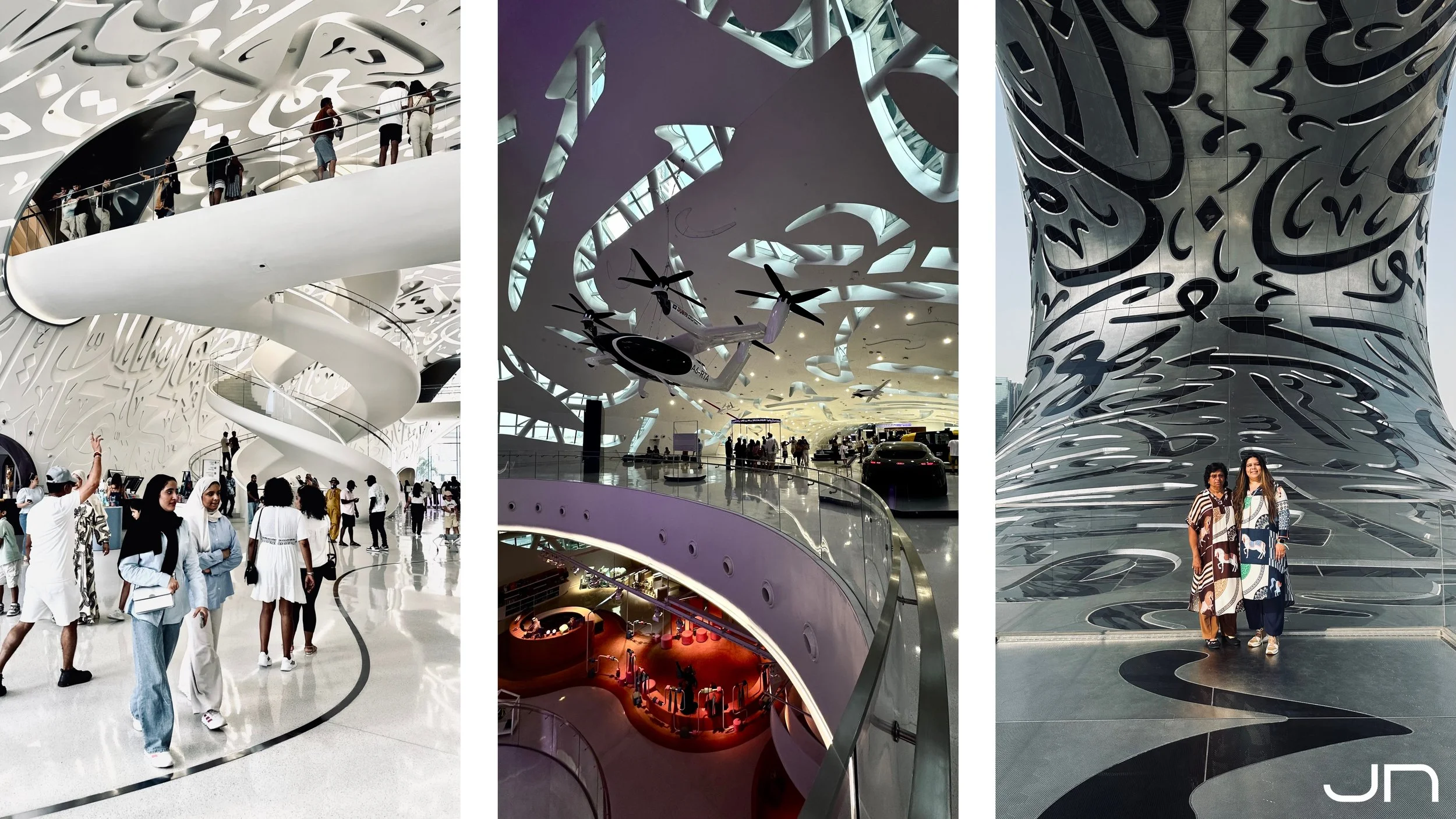
The façade’s flowing Arabic calligraphy transforms written language into architectural matter. Cut through the steel skin, each stroke forms a physical incision, giving words a tangible depth. This is text as texture — script that becomes surface. The calligraphy doesn’t just decorate the building; it defines its material presence. The words are no longer flat symbols on a page — they are architectural, tactile, inhabiting the skin of the structure. Each curve and line rises from the surface like embossed language, transforming script into material.
In daylight, the façade reads like a metallic membrane. The glazed calligraphy appears opaque in the desert sun but casts soft shadows across the curvature of the interior volume, changing subtly as the sun moves. This interplay of light and shadow turns the surface into a living, breathing material — one that blurs the boundaries between inscription and construction, ornament and structure.
The façade becomes an interface between body and meaning, inviting us to imagine what it might feel like to trace a finger across its cool metal surface, following the rhythm of words as though they were woven into fabric. But the shift from reading the calligraphy on the exterior to sensing the atmosphere created on the interior makes the building more than an object of sight. Here, text does not merely communicate — it embodies.
The Ephemeral Museum
Inside, the experience continues in this tension between the tangible and the intangible. Light filters through the calligraphic openings, scattering patterns that move gently across interior walls. The result is a space defined as much by lightness as by material — an architecture that aspires toward the immaterial while remaining rooted in form.
The Museum of the Future captures a rare balance: a building made of the heaviest of materials — metal, glass, concrete — yet one that feels as though it could dissolve into light at any moment. It reminds us that the essence of architecture is not only in what is built, but in what is felt — in the fleeting moments when surface, light, and air converge to create atmosphere.
Here, materiality and ephemerality coexist. The steel skin may endure, but its meaning is in constant motion — rewritten each day by the desert sun and re-illuminated each night by light’s quiet conversation with form.
Lighting as Dialogue
As night falls, light slips into the carved calligraphy, transforming the building from an object of reflection into one of revelation. Embedded LEDs trace the script from within, making each word glow softly against the dark sky. In this moment, light becomes a dialogue — not merely illumination, but communication.
It is as if the building begins to speak through its own skin. The glowing script recasts the metal’s rigidity into something ephemeral, weightless. Architecture, often thought of as static and permanent, becomes transient, responsive — alive to the rhythms of dusk and atmosphere.
If the calligraphy is texture by day, by night it becomes dialogue. Light embedded within the strokes animates the words, turning them into luminous sentences that float across the building’s curved body.
This interplay of illumination and shadow creates a conversation: between inside and outside, between viewer and surface, between word and world. The glowing script is not static; it pulses with atmosphere, altering how the building feels as the desert sun sets and the night takes hold.
In this way, the Museum of the Future reminds us that light in architecture is never neutral. It can act as a voice — not just revealing form, but giving it expression. When the façade speaks through light, it is not only decoration, but narrative, presence, and mood.
Atmosphere Beyond Sight
The genius of this building lies in how it extends architecture beyond visual spectacle. Words, normally confined to pages or screens, are lifted into three-dimensional space; light, normally an afterthought, becomes an active participant. Together, they create a sensory atmosphere that is at once physical and poetic.
The result is a building that doesn’t just house exhibitions about the future — it embodies a vision of what architecture itself can be: a place where texture and dialogue replace silence, and where language and light shape not only what we see, but how we feel.