
THE ASV BLOG
— by JANICE NINAN

TOUCHING HISTORY
Tactile Tuesdays | The Material Memory of the Berlin Wall
Some architectures are built to shelter.
Some to monumentalize.
And some — like the Berlin Wall — are built to divide.
But decades after its fall, what remains of the Wall is no longer a symbol of separation. Today it exists as a tactile archive, a material landscape where memory is embedded in concrete, steel, earth, and scar. Walking along the former border, you don’t just see history — you feel it. Across textures, voids, fragments, and surfaces, Berlin reveals a city continuously stitching itself back together.
Material Fragments as Memory Fragments
The Berlin Wall no longer appears as a single structure. It survives through scattered remnants — some monumental, others almost invisible:
Reinforcement bars emerging from the ground like exposed ribs
Concrete stumps eroded down to their aggregates
Metal bands and stone strips marking the Wall’s original path
New steel partitions aligned exactly where the border once stood
Museum installations mapping both its presence and absence
Together, these pieces form a constellation of material memory. Touching the concrete’s rough, porous face feels like reading an archive carved by weather, conflict, and time. The Wall persists not as an object, but as a series of tactile encounters.
Concrete as Witness
Berlin’s concrete holds its history unapologetically.
Up close, its surface reveals:
Years of weathering
Graffiti that once protested division
Scratches and pits from attempted escapes
Imperfections from rushed construction
Concrete is usually considered hard, cold, and inert — yet here it behaves almost like skin. It absorbs stories. It carries trauma. It softens at the edges but hardens in meaning. The exposed rebar, now rusted and delicate, reveals the internal anatomy of a structure that once defined geopolitical reality. Its material honesty is disarming.
New Steel Against Old Concrete: A Dialogue of Eras
In several stretches, Berlin places a new metal wall directly beside the original concrete.
The contrast is intentional:
Old concrete is rough, heavy, and absorptive.
New steel is smooth, cool, and reflective.
Together, they form a quiet architectural dialogue — a threshold between what was and what is. The pairing is not about reconstruction; it is about recognition. The city chooses to remember through juxtaposition rather than erasure. In this layered condition, the tactile story becomes richer.
The Church of Reconciliation: Architecture as Healing
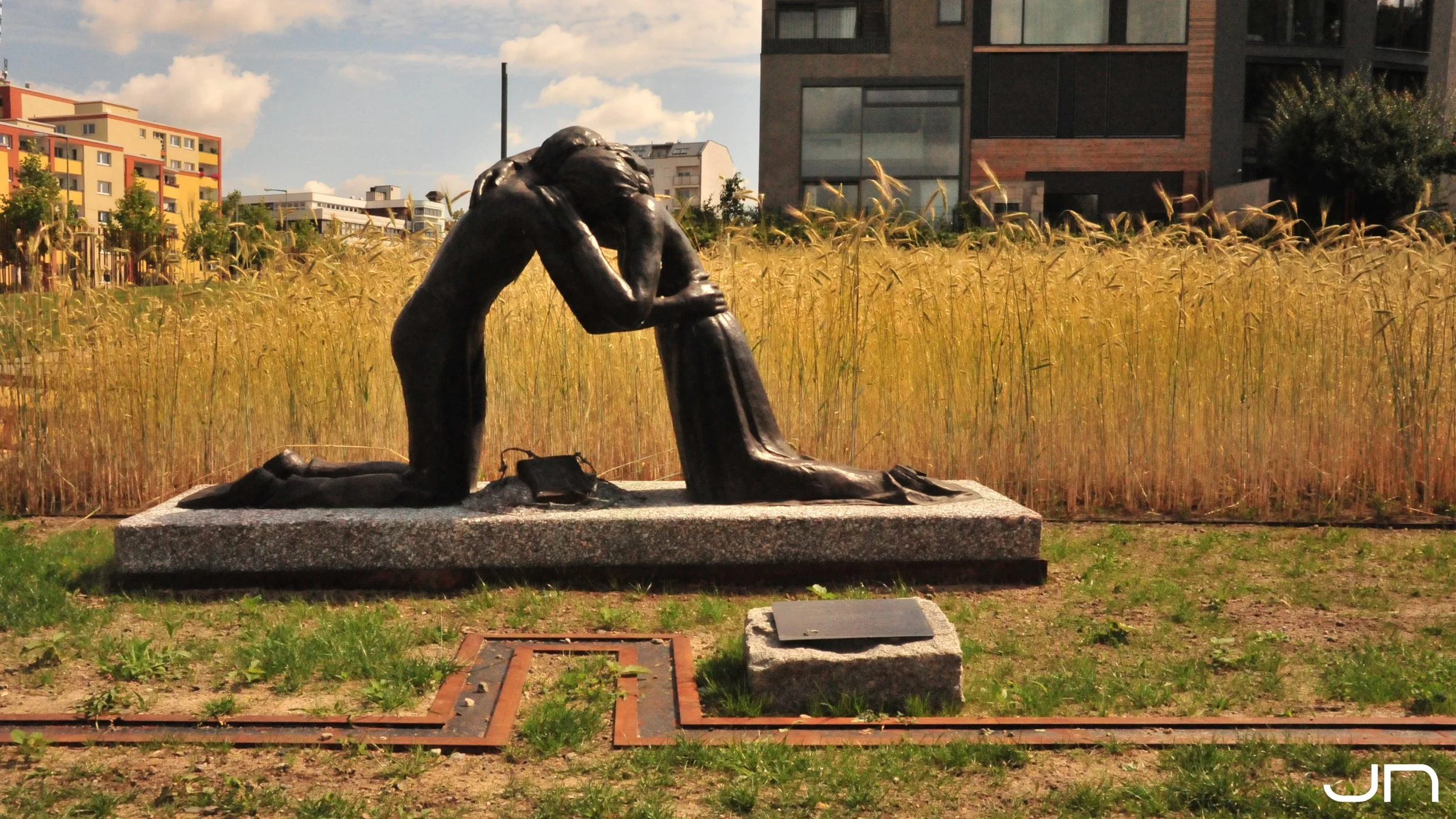
One of the most moving sites along the former border is the Church of Reconciliation, rebuilt on the footprint of a church destroyed in 1985 when it stood stranded in the death strip.
The new church, made of rammed earth mixed with clay from the site, carries fragments from the ruins within its walls — brick pieces, stones, glass shards. You can see them embedded in the material. You can touch them. The building becomes an act of architectural healing, binding fragments of the past into a grounded present.
Outside, a sculpture of a kneeling man and woman embraces along the ghosted outline of the original church walls. Their gesture mirrors the city’s own — a collective bending toward reconciliation.
Graffiti, Stamps, and Collective Imprint
Large reassembled segments of the Wall stand today as open-air galleries. These surfaces — once instruments of oppression — have transformed into vibrant layers of public participation.
Graffiti, signatures, checkpoint stamps, stickers, and drawings cover the concrete. Each mark is a personal encounter, a moment of contact. The Wall no longer enforces division; instead, it gathers a global community around it.
In these installations, materiality becomes democratic. People touch the Wall, take photographs before it, and imprint their own stories onto its surface. The concrete accepts it all, becoming an evolving canvas of collective memory.
Touching History: Materiality as Sensory Archive
What makes the Berlin Wall so affecting today is not only its history, but its tactility. The city allows you to experience memory through touch, scale, texture, and presence.
You feel history when:
Your fingers skim a pitted concrete surface
Your palm rests against cool, new steel
Your feet follow the stones tracing the Wall’s old path
Your eyes read the layered graffiti and markings
Your body stands in the void where a building once stood
This is architecture as sensory record.
Materiality becomes a vessel for memory — not abstract, but embodied.
Why the Berlin Wall Still Matters to Designers
For architects and designers, the Berlin Wall offers a profound lesson:
Materials remember.
Concrete can carry trauma.
Steel can articulate clarity.
Earth can hold grief and healing simultaneously.
Graffiti can become a people’s archive.
The Wall demonstrates that architecture holds emotional resonance long after its political use fades. Rebuilding is not only technical — it is cultural, tactile, and deeply human.
Walking these remnants, photographing their layers, and tracing their textures is a reminder that cities metabolize pain through material decisions. Berlin teaches us that memory lives not only in monuments, but in fragments, scars, and deliberate acts of reconstruction.
Closing Reflection
The Berlin Wall once divided a city.
Today, its remnants connect people across time.
Through concrete, earth, steel, and public inscription, Berlin transforms conflict into tactile memory. It invites us to touch history, to read it through materials, and to witness how architecture can carry the stories we cannot afford to forget.
Some walls fall.
But the materials remain — offering tangible lessons in resilience, reconciliation, and the quiet power of design.