
THE ASV BLOG
— by JANICE NINAN

LANDSCAPE AS A THRESHOLD
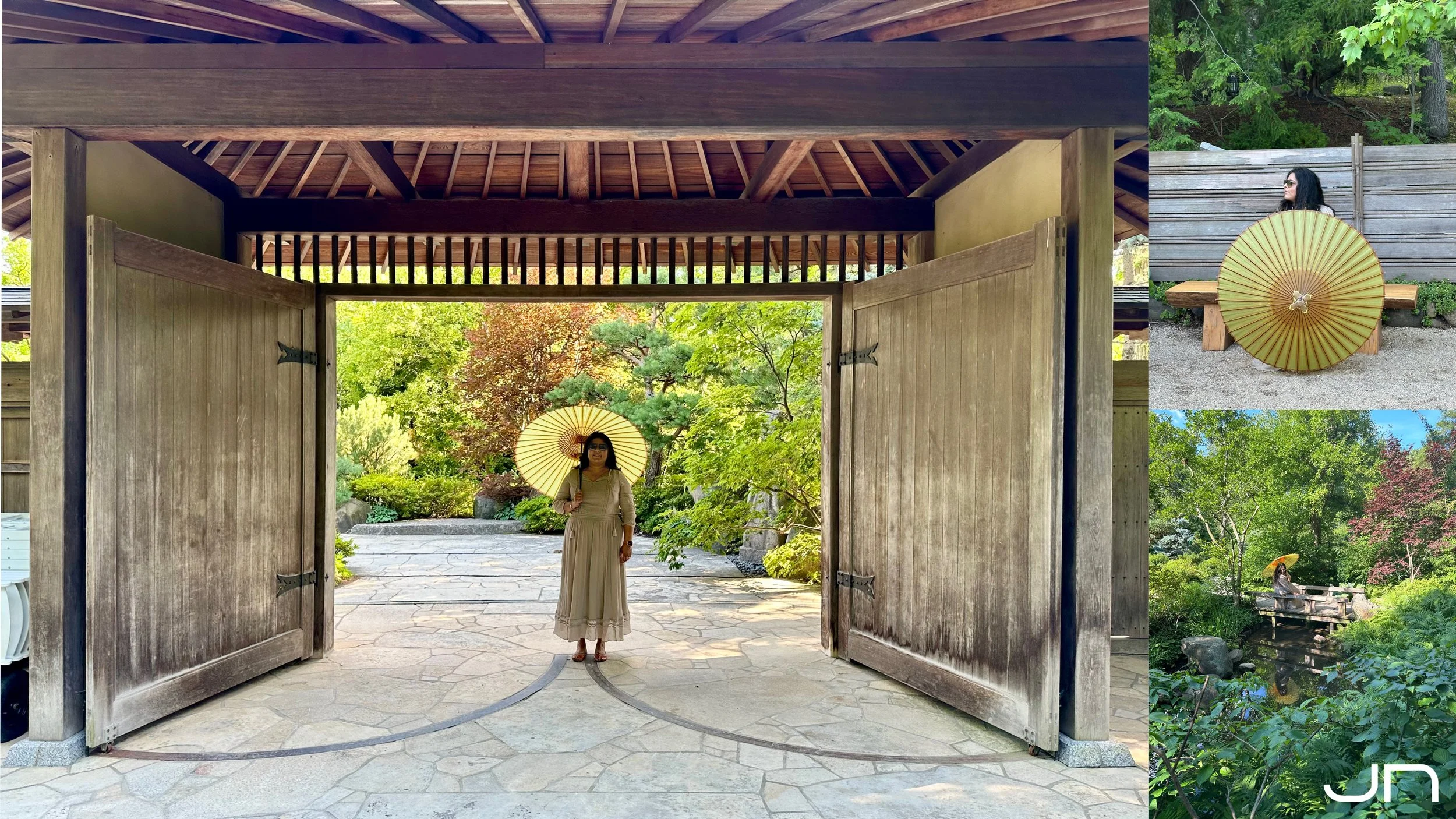
Threshold Thursdays | The Anderson Japanese Garden unfolds as a quiet threshold - guiding the body from movement into mindful stillness.
I did not enter Anderson Japanese Gardens all at once.
I crossed into it.
That distinction matters—because this landscape does not announce itself loudly or demand attention. Instead, it reveals itself gradually, teaching you how to move, how to pause, and how to see. From the moment you step inside, the garden functions as a sequence of thresholds—each one subtle, deliberate, and deeply intentional.
Arrival: Leaving the Ordinary Behind
The first threshold at Anderson Japanese Gardens is not marked by gates or signage. It is marked by a change in rhythm.
The noise of the outside world softens. Footsteps slow. Paths narrow. Views are carefully framed so that you never see too far ahead. This controlled unfolding creates anticipation—not of spectacle, but of presence. The garden does not rush you toward a destination; it draws you inward.
Here, landscape replaces architecture as the primary guide.
Paths as Transitional Devices
Every path in the garden is a lesson in movement. Stone underfoot changes in size, texture, and alignment, quietly instructing the body to adjust its pace. Curves obscure what lies ahead, turning each step into a moment of discovery rather than efficiency.
These paths are thresholds in motion—never static, never abrupt. You are constantly transitioning: from light to shade, from openness to enclosure, from sound to silence.
The garden reminds you that thresholds do not have to be doors.
Water as a Threshold Element
Water is everywhere, but never intrusive. Streams, waterfalls, and still ponds act as psychological and spatial boundaries. Crossing a bridge—even a small one—feels ceremonial. It marks a shift, not just in location, but in attention.
Reflections blur the line between what is real and what is perceived. Sky becomes water. Stone becomes shadow. In these moments, the garden asks you to look twice—and then to slow down even more.
Water here is not decoration. It is transition made visible.
Framed Views and Borrowed Scenery
One of the most powerful threshold moments in the garden comes through what is revealed—and what is withheld. Trees, rocks, and structures frame views deliberately, often borrowing distant scenery and pulling it into the immediate experience.
You never receive the entire garden at once. Each reveal feels earned. Each pause feels necessary.
This is landscape as narrative: a carefully paced sequence of spatial chapters.
Structures That Do Not Dominate
The garden’s built elements—pavilions, bridges, tea-house-inspired forms—do not interrupt the landscape. They exist within it, as moments of shelter rather than control.
These structures feel less like objects and more like punctuation marks—commas rather than exclamation points. They provide rest, reflection, and orientation without ever breaking the spell of continuity.
Architecture, here, becomes a threshold itself.
Silence as a Designed Condition
Perhaps the most striking threshold at Anderson Japanese Gardens is internal.
Somewhere along the path, you realize you are listening differently. You hear wind in leaves. Water against stone. The subtle crunch of gravel beneath your feet. The garden has shifted your sensory priorities.
This is not accidental. It is design working at its deepest level—changing how you perceive rather than what you see.
Crossing Back
Leaving the garden feels different than entering it. The return path does not undo the experience; it carries it forward. You exit slower than you arrived. Quieter. More aware.
The final threshold is not physical—it is the moment you re-enter the world, carrying the garden’s calm with you.
And that, perhaps, is the highest achievement of this landscape:
It does not end at its boundary.
Landscape as Threshold
At Anderson Japanese Gardens, landscape is not background or ornament. It is the primary architectural device. It mediates between states of being—between noise and stillness, movement and pause, outside and inside.
This garden does not ask to be consumed.
It asks to be crossed.
And in doing so, it reminds us that the most powerful thresholds are not the ones we see—but the ones we feel.
RAMMED EARTH AND REMEMBERANCE
Tactile Tuesdays | Tactility as memory. Clay as reconciliation. Architecture as dialogue with the past.
Architecture of the Church of Reconciliation, Berlin
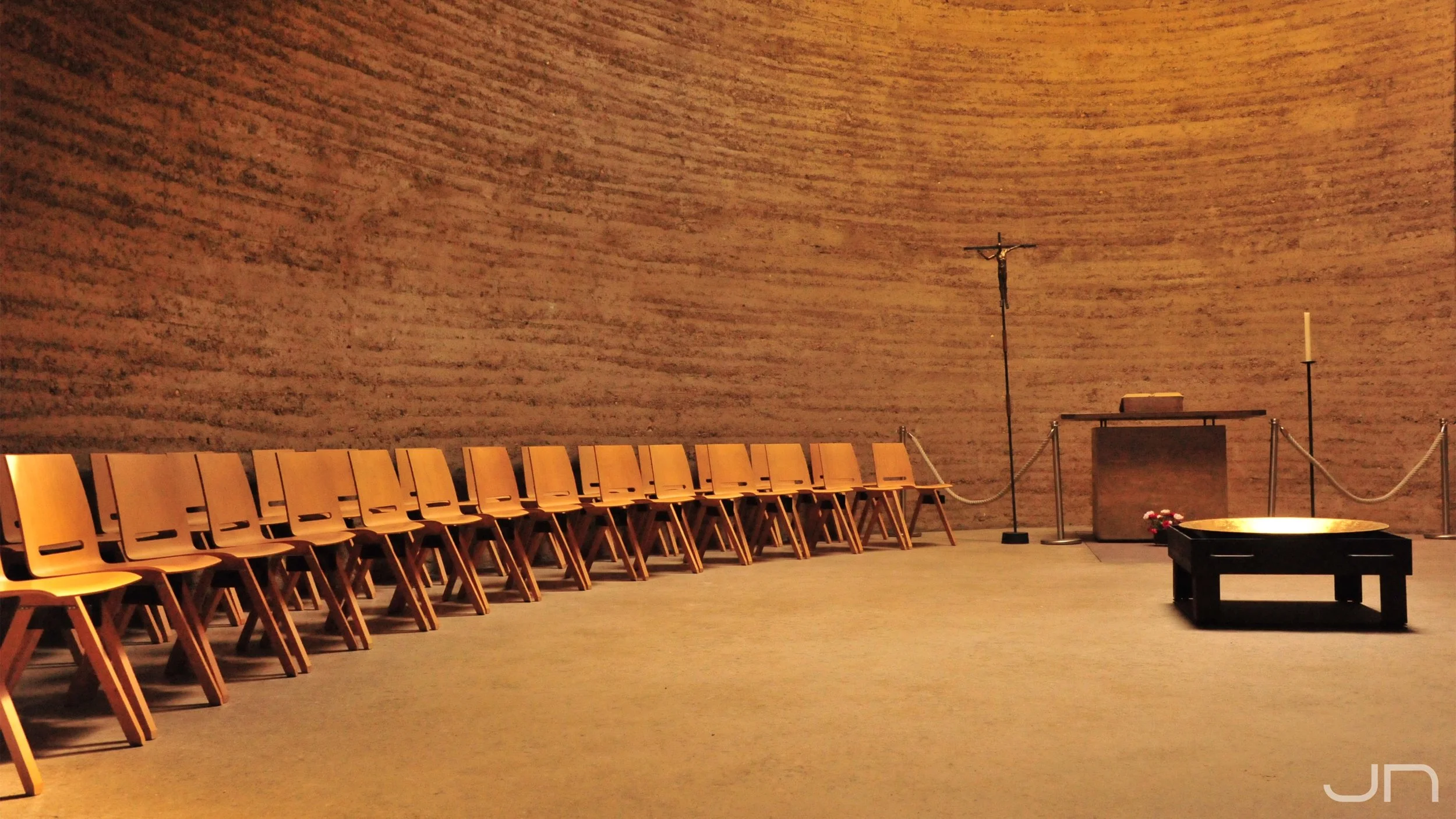
On Bernauer Strasse in Berlin, architecture and memory meet in a profound way. Here, the Church of Reconciliation stands as both a spiritual space and a physical reminder of the city’s fractured past. The original church, trapped between the barriers of the Berlin Wall, was destroyed in 1985. Its absence became an emblem of division, but its rebirth in 2000 gave the city a new symbol—one rooted in healing.
What makes the new structure remarkable is not only its circular form or its contemplative presence, but the choice of material: rammed earth walls made from clay gathered directly from the site of the former Berlin Wall. In this act, soil once synonymous with separation was transformed into a vessel of unity and reconciliation.
Clay is not a neutral material. It holds warmth, absorbs moisture, and reveals texture in a way that concrete or steel never can. Inside the chapel, the tactility of the walls changes the experience of space. Light is absorbed softly rather than reflected harshly. Sounds are muffled, giving the interior an almost hushed intimacy. The walls, layered by hand and pressure, display striations of earth that feel both fragile and timeless.
To press your hand against the clay is to feel its porosity, its roughness, its grounding presence. It makes history tangible. The wall is not polished smooth, not distanced from touch, but instead invites the visitor to physically engage with it. In doing so, one confronts both the pain of division and the possibility of reconciliation—quite literally embedded in the earth.
The use of clay here is more than a sustainable material choice. It is an ethical and poetic gesture: memory made tactile, history rebuilt into a place of peace. The Church of Reconciliation shows us how architecture can hold space for healing—not only through form and light, but through the direct materiality of touch.
Concrete, Stilled: Tactile Encounters at the Pulitzer Foundation
Tactile Tuesdays | The Atelier Diaries
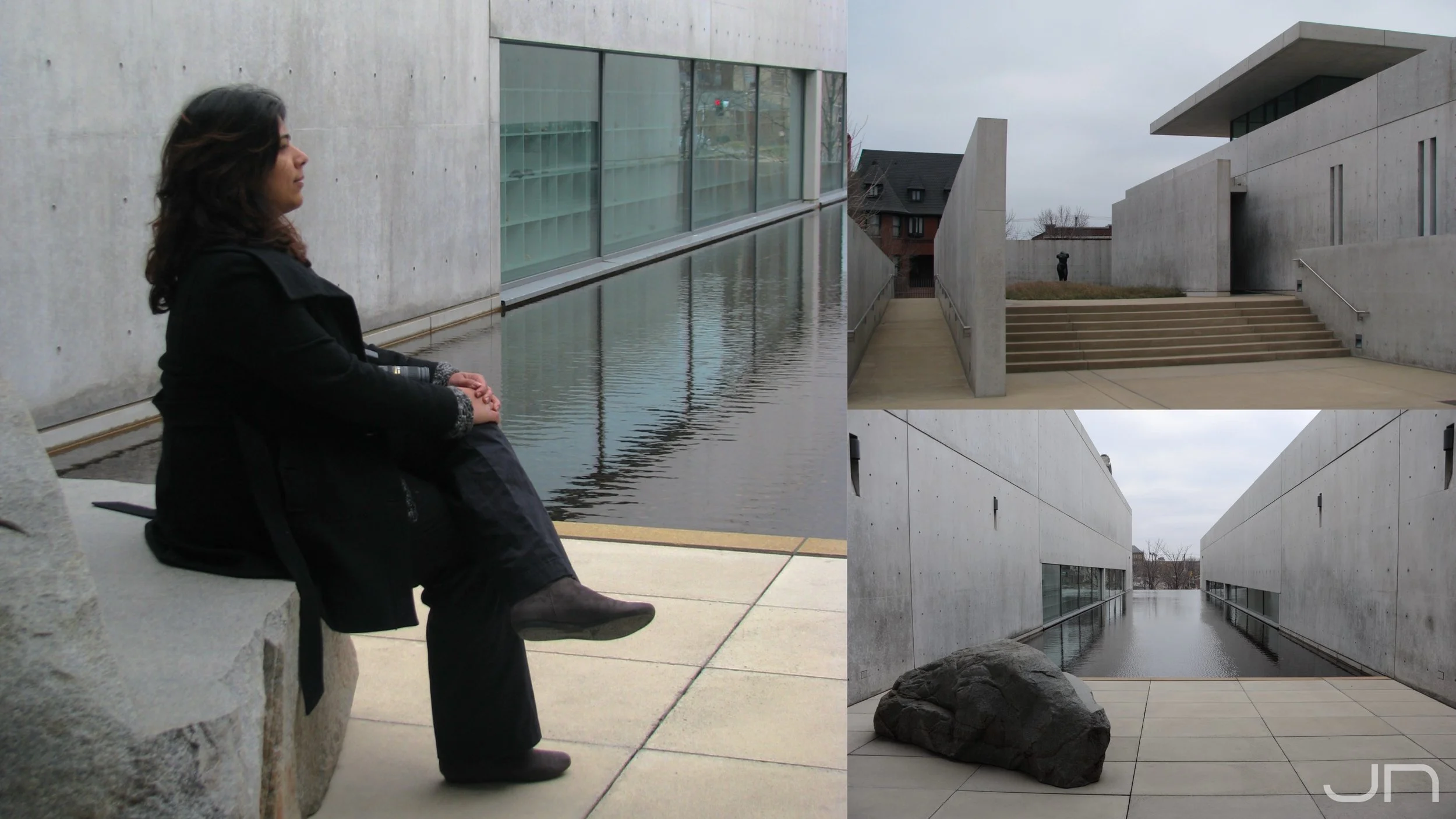
There are buildings that impress, and then there are buildings that quiet you. The Pulitzer Foundation for the Arts in St. Louis — designed by Tadao Ando — is the latter. I visited it not for spectacle, but for stillness. Ando gave me both.
The architecture doesn’t scream. It breathes. And its primary language is concrete.
The Weight of Silence
The moment I stepped inside, the world slowed. What struck me first wasn’t the form or function — it was the weight of the quiet. Ando’s concrete isn’t brutish or cold. It’s monastic. Still. Thoughtful.
Each ply-formed surface reads like a fossilized imprint of craft — a record of time, pressure, labor, and intention. The material holds memory in its grain. It receives light in a way that feels deeply human.
Concrete as Skin
This isn’t the concrete of parking garages and freeways. This is concrete made tactile — not to be touched, but to touch you.
In the Pulitzer’s galleries and corridors, the concrete walls glow under filtered daylight, their surfaces softened by shadow. The edges are precise, but the experience is sensory. I didn’t just see the concrete. I felt it in the way it held space.
It reminded me that materiality is not just a question of aesthetics or durability — it’s an emotional register. A medium of mood.
A Material Lesson
As a designer, I’m always looking for how materials speak. At the Pulitzer, the concrete didn’t shout. It whispered. It invited stillness. Reflection. Reverence.
Ando’s approach reaffirmed something I return to again and again in my own work: the power of restraint. That space doesn’t always need to explain itself. Sometimes, it just needs to hold you — gently, firmly, silently.
Closing Reflection
Tactile Tuesday is about more than surface. It’s about experience. And this one stayed with me.
“You don’t touch the concrete — not literally. But it touches you.”
— Architecture Speaks Volumes
Have you visited a space that made you feel something — not for how it looked, but how it held you? I’d love to hear.
Leave me a comment on instagram → @architecturespeaksvolumes