
THE ASV BLOG
— by JANICE NINAN

LESSONS THAT OUTLAST STUDIO
Studio Saturdays | What we carry forward from Architecture school isn’t just technique - it’s a way of seeing the world.
Architecture school ends long before architecture leaves you.
Degrees are framed, studios are cleared out, and life moves on — into offices, job sites, solo practices, or parallel creative paths. But long after the final jury, there are things we carry forward quietly. Not resumes or portfolios, but habits of mind, ways of seeing, and deeply ingrained rituals that continue to shape how we work and how we live.
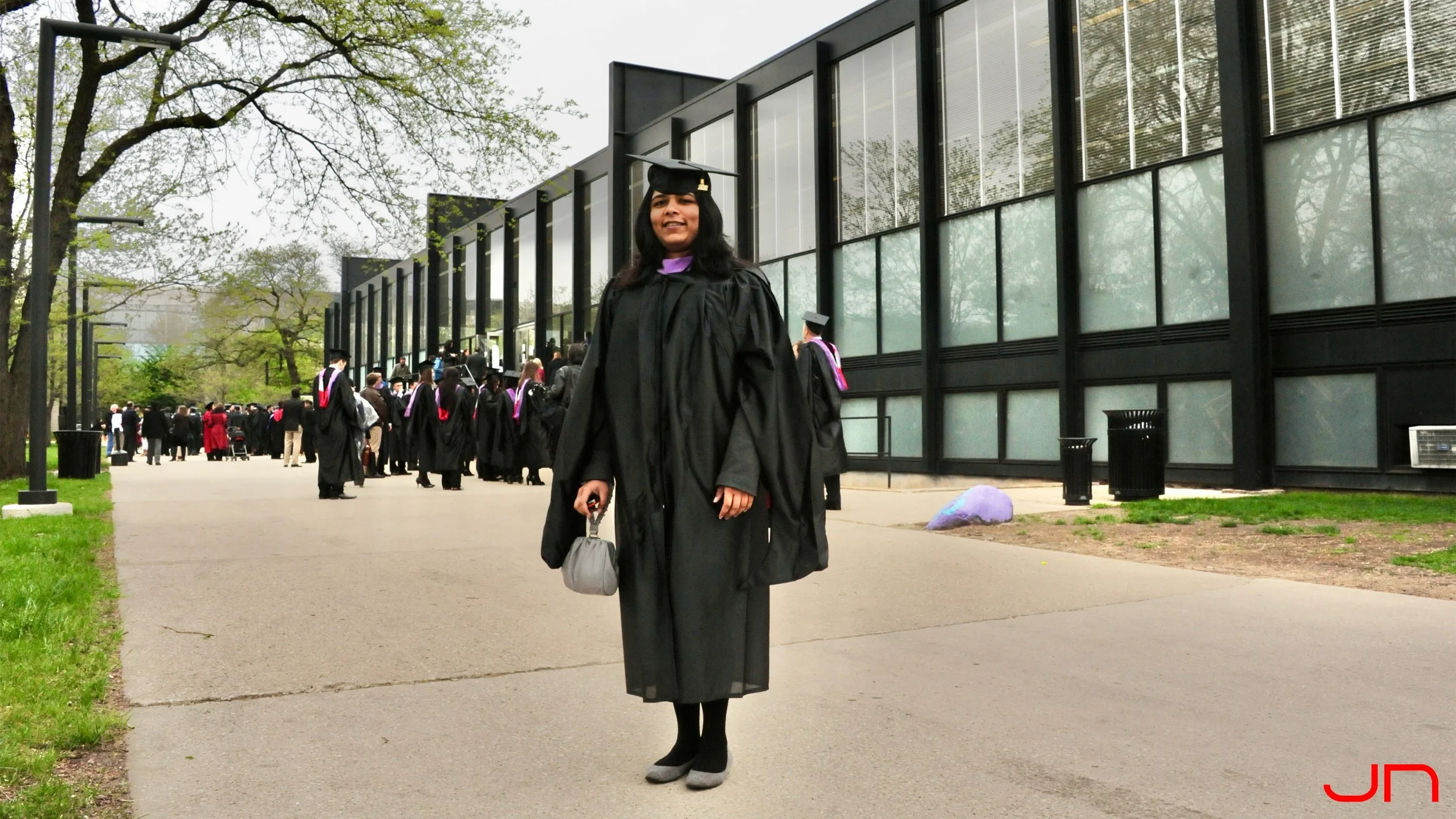
I earned my Bachelor of Architecture at MSRIT, Bangalore, and later my Master of Architecture at IIT Chicago. Two different continents, cultures, climates, and pedagogies — yet remarkably similar studio truths. What I carry forward from architecture school has less to do with buildings, and everything to do with practice.
1. The Discipline of Showing Up
Architecture school teaches you to show up — even when you’re tired, uncertain, or uninspired. Studio doesn’t wait for perfect conditions. Deadlines arrive whether the idea is ready or not.
That discipline stays with you.
It becomes the quiet ability to sit down and begin. To open the sketchbook. To draft the first imperfect line. To return to the work again and again, trusting that clarity emerges through engagement, not avoidance.
2. Seeing Before Solving
Before architecture school, I thought design was about answers. School taught me it’s about questions.
At MSRIT, site visits trained my eye to context — climate, material, scale, human movement. At IIT Chicago, studying within the rigor of Crown Hall sharpened my understanding of structure, logic, and spatial discipline. Together, they instilled a habit of looking deeply before responding.
This way of seeing extends beyond architecture. You start noticing how light enters a room, how people occupy space, how cities reveal their histories in fragments. Observation becomes instinct.
3. Comfort with Critique
Few experiences shape you like a studio critique.
Standing beside your work while others dissect it teaches resilience, humility, and discernment. You learn that critique is not rejection — it’s conversation. You learn how to listen without collapsing, how to defend ideas without ego, and how to extract value even from difficult feedback.
That ability to separate yourself from your work becomes invaluable — in practice, collaboration, and life.
4. The Power of Process Over Perfection
Architecture school rewards thinking out loud. Sketches, diagrams, trace overlays, models — all evidence of a mind at work.
What stays with you is the understanding that the process matters as much as the final outcome. That unfinished drawings can be more revealing than polished renders. That iteration is not failure, but fluency.
This belief becomes grounding in a world obsessed with finished images. You learn to value the work-in-progress.
5. Time Pressure as a Creative Tool
Studio deadlines are unforgiving — and oddly transformative.
Under time pressure, you learn to prioritize. To let go of unnecessary complexity. To trust intuition. Those late nights train you to make decisions with incomplete information — a skill essential to real-world practice.
Even today, I often return to timed sketching and constrained exercises. Not as nostalgia, but as a way to reconnect with creative clarity.
6. Community as Catalyst
Architecture school is never a solitary experience.
From all-nighters to site visits, shared meals to shared panic before juries — studio creates a unique form of collective learning. You grow not just from your own work, but from watching others struggle, experiment, and succeed.
That sense of creative community is something I consciously seek to recreate today — through initiatives like Studio Saturdays and Thursday Throw Downs. Architecture thrives in circles, not silos.
7. A Lifelong Relationship with Learning
Perhaps the most enduring thing architecture school teaches you is that you will never finish learning.
Every project introduces new constraints, materials, regulations, and human needs. School doesn’t prepare you with all the answers — it prepares you to keep asking better questions.
That mindset stays with you whether you remain in traditional practice or forge your own path.
Carrying It Forward
What we carry forward from architecture school isn’t just technique — it’s temperament.
The patience to observe.
The courage to iterate.
The discipline to show up.
The humility to listen.
The belief that design is a form of service.
These are the invisible tools that continue to shape my work through Architecture Speaks Volumes and The ASV Atelier — long after graduation ceremonies have faded into memory.
Architecture school may end, but studio never really does.
The Art of the ‘Throw-Down’
Studio Saturdays | Building community one sketch at a time.
There’s a certain kind of magic in sketching on location — the kind you can’t replicate in the studio, no matter how sharp your pencil or how big your desk.
I first felt it during my study abroad program in Europe. Our professor, John DeSalvo, would take us to a piazza, a cathedral square, or a tucked-away alley framed by centuries-old stone. The instructions were simple:
“Here’s the architectural subject.
Pick your spot.
You have 30 minutes.
Go.”
We’d scatter — some gravitating toward the front steps of a church, others to the cool shadow of a colonnade or a cafe bench beneath a tree. We had half an hour to capture the subject given, to draw whatever caught our eye: the physical or ephemeral; the macro or micro.
When time was up, the real magic happened.
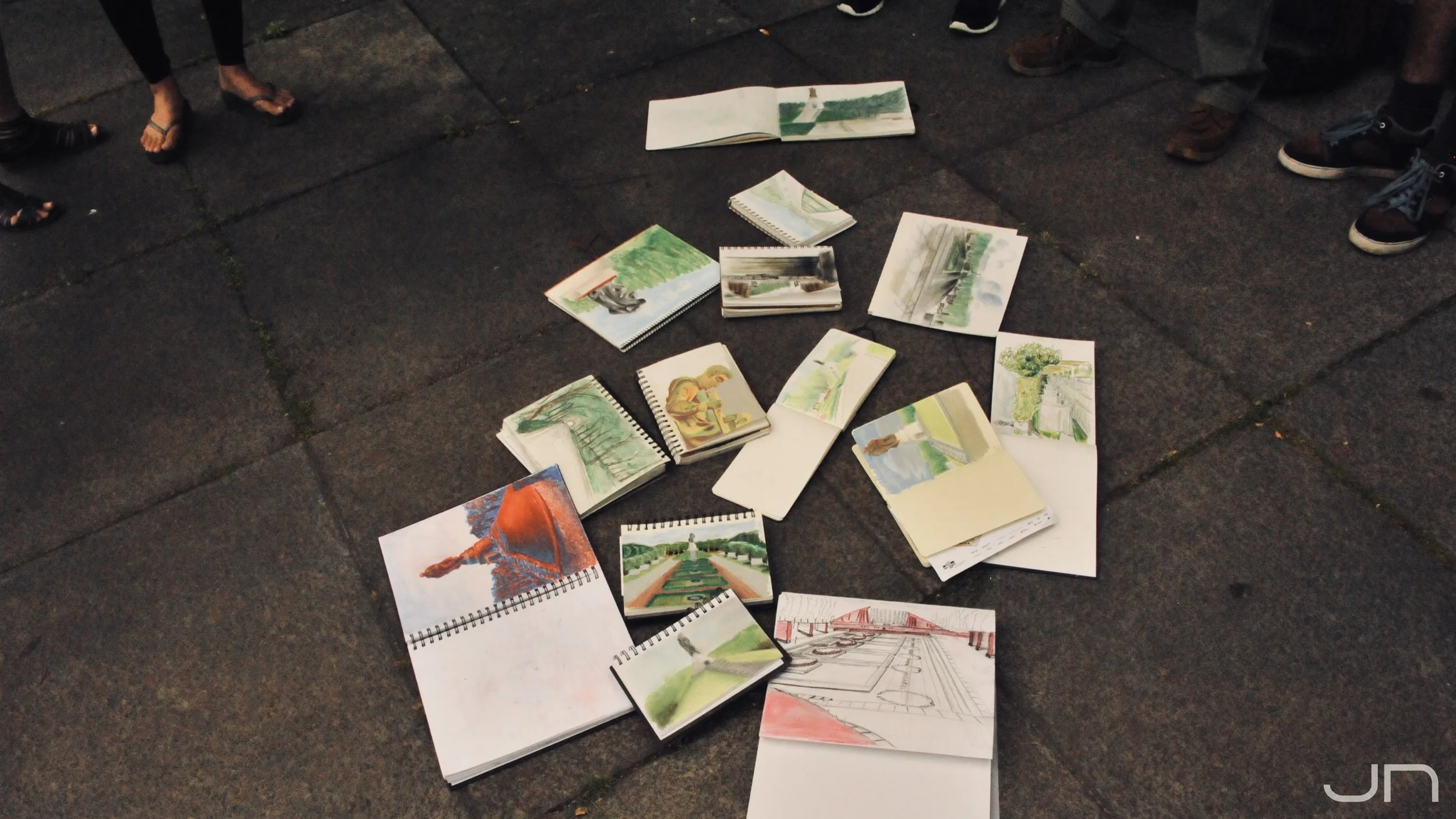
We’d gather in a circle, standing right there on site, and open our sketchbooks for what we called a sketchbook throw-down.
The Throw Down Ritual
The throw down was never a competition — it was a celebration. We’d lay our sketchbooks open so everyone could see: watercolors still damp, pastels and ink lines still smudging if you weren’t careful.
The beauty was in the variety. Twelve people could stand in the same space and come away with twelve completely different interpretations of the same architectural subject. Some sketches were all about precision; others captured atmosphere. A few honed in on details you hadn’t even noticed. It was a reminder that architecture isn’t just about what’s there, it’s about what each person sees.
Why Travel Sketching Matters
Looking back, those 30-minute sessions shaped me as a designer in ways I’m still grateful for. Here’s why I believe travel sketching is a practice worth keeping — whether you’re an architect, artist, or just a curious traveler:
1. It Sharpens Observation
When you’re sketching, you’re not just glancing — you’re studying. You notice lines, edges, proportions, materials and patterns you’d otherwise walk past.
2. It Trains Speed and Confidence
Thirty minutes is just enough time to make decisions but not enough to second-guess every line. You learn to commit and move forward.
3. It Captures Memory Differently
A photograph records what’s in front of you. A sketch records how you experienced it — what you chose to include, what you left out, how the colors felt.
4. It Builds Community
The throw down itself is a shared act. It’s about seeing through each other’s eyes, and realizing how diverse creative vision can be.
From Piazza to Present: Thursday Throw-Downs
Those circles of sketchbooks, held open to the sun, have stayed with me. They’re a tradition I want to bring into my work today — not just for nostalgia, but because I believe the throw down is a powerful way to connect people through creativity.
That’s why I’m building a new ASV community initiative called Thursday Throw-Downs.
The idea is simple:
• Once a week, people across the world will take 30 minutes to sketch — a building, a space, a corner of their own street.
• We’ll share our work together, online or in person, just like we did in the piazzas.
• It’s open to anyone, from seasoned architects to first-time sketchers.
Some weeks, I’ll host online sketch prompts so we can all work on the same theme. Other weeks, I’ll gather a local group for an on-site throw-down, where we can stand in that familiar circle, pages open, seeing what each other saw.
Why Thursday?
Because Thursdays are the perfect almost-weekend energy. Enough time to pause, make something, and connect — and still carry that creative spark into the weekend.
Travel sketching taught me that design is not just about buildings — it’s about perception, patience, and sharing your way of seeing the world. Thursday Throw-Downs will be a space for exactly that: fast lines, fresh perspectives, and a circle of people who understand that the best sketches are never perfect — they’re alive.
Stay tuned or the first Thursday Throw-Down announcement here on Architecture Speaks Volumes. I hope you’ll join me, with your choice of medium in hand.