
THE ASV BLOG
— by JANICE NINAN
THE PLEIN AIR STUDIO
Studio Saturdays | Architecture lessons from Travel.
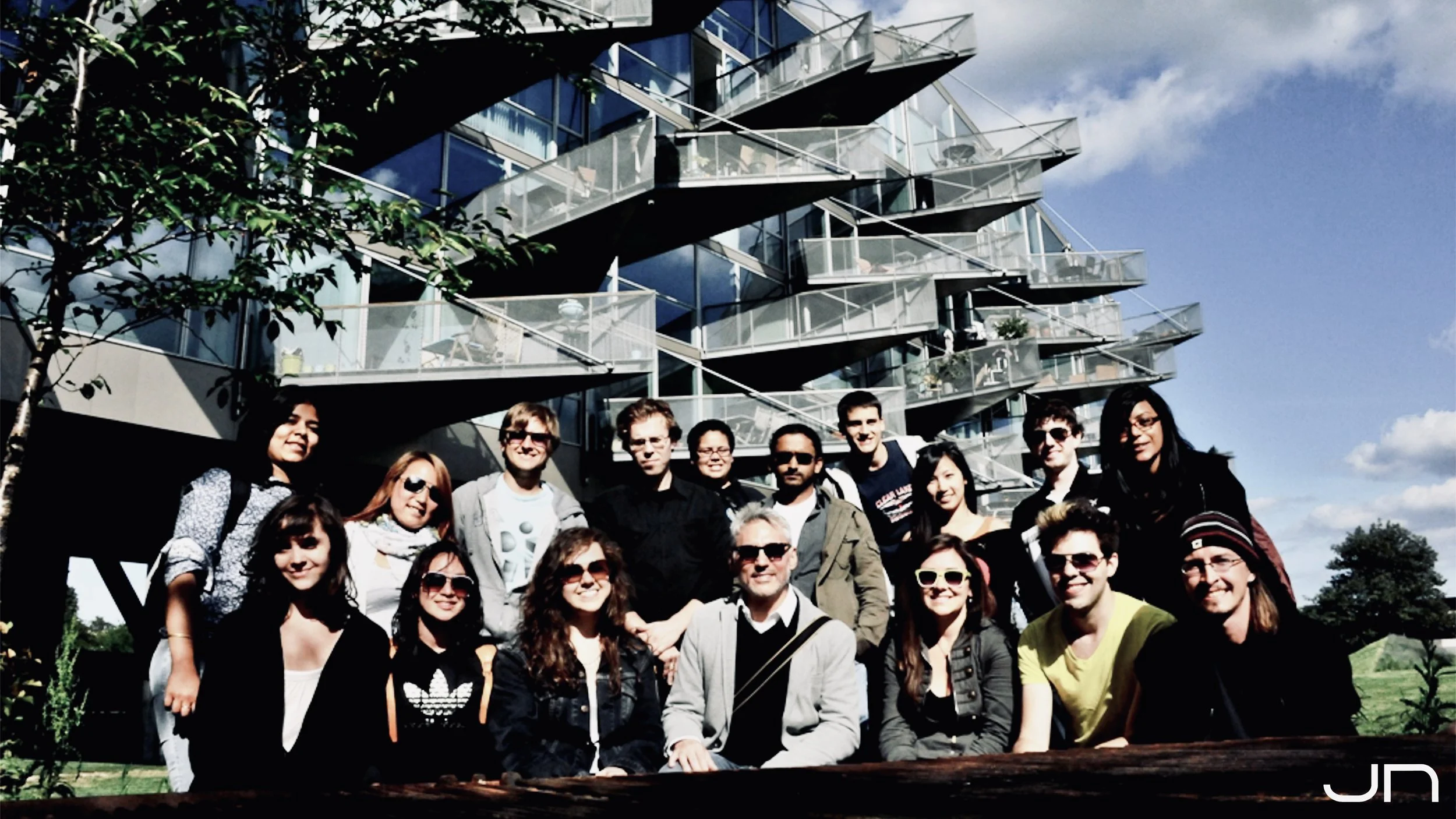
For architecture students, the city is the most profound classroom. Its buildings, streets, and public spaces hold lessons no model or textbook can fully capture. This is why traveling studios and study abroad programs are so transformative—they immerse us in both the artistry and the mechanics of design, while teaching us to read the architecture that speaks volumes.
Drawing as a Way of Reading
In my European travel studio, one of our courses was devoted entirely to sketching. Armed with pencils, ink, charcoal, pastel, and watercolors, we spent our days on site, translating cities into marks on paper. Each medium became a different voice: the precision of ink, the softness of charcoal, the immediacy of watercolor.
Sketching trained us to read architecture like a text—the rhythm of windows, the weight of stone, the cadence of light across a façade. Each line became a sentence; each shadow, a paragraph. To sketch was to enter into dialogue with buildings, to discover how architecture speaks if we slow down enough to listen.
Technology as Translation
Running parallel to sketching, our second course explored building technologies. Here, we learned to decode the structural and material systems behind the spaces we admired: masonry vaults, thermal mass, glazing, spans. If sketching taught us to hear the poetry, technology revealed the grammar—the framework that makes meaning possible.
This dual focus—art and science, hand and detail—reminded us that architecture is both language and logic, expression and execution.
Learning in Context
The studio experience extended beyond coursework. Traveling together through unfamiliar cities, we learned collaboration in its most organic form: critiquing sketches at café tables, passing charcoal across a piazza, or discussing systems and spans on a train ride between stops. Each city became a new chapter to interpret, each sketchbook page a translation of what we saw and felt.
Why It Endures
Traveling studios teach us that architecture is not abstract—it is lived narrative. To sketch by hand is to hear its voice; to study technologies is to understand how that voice is carried. Together, these courses revealed that the built environment is never silent. If you know how to look, every building, every street, every material speaks.
When I look back at our final presentation—a plethora of mixed media sketches distilled from weeks of travel—I see more than drawings. I see the first attempts at fluency in the very language that defines my practice: Architecture Speaks Volumes.
A Call to Future Architects
If the chance comes to join a traveling studio, take it. You will return not only with a sketchbook and technical knowledge, but with the ability to read architecture as text, as voice, as memory.
Because architecture does not whisper. Architecture Speaks Volumes.
The Art of the ‘Throw-Down’
Studio Saturdays | Building community one sketch at a time.
There’s a certain kind of magic in sketching on location — the kind you can’t replicate in the studio, no matter how sharp your pencil or how big your desk.
I first felt it during my study abroad program in Europe. Our professor, John DeSalvo, would take us to a piazza, a cathedral square, or a tucked-away alley framed by centuries-old stone. The instructions were simple:
“Here’s the architectural subject.
Pick your spot.
You have 30 minutes.
Go.”
We’d scatter — some gravitating toward the front steps of a church, others to the cool shadow of a colonnade or a cafe bench beneath a tree. We had half an hour to capture the subject given, to draw whatever caught our eye: the physical or ephemeral; the macro or micro.
When time was up, the real magic happened.
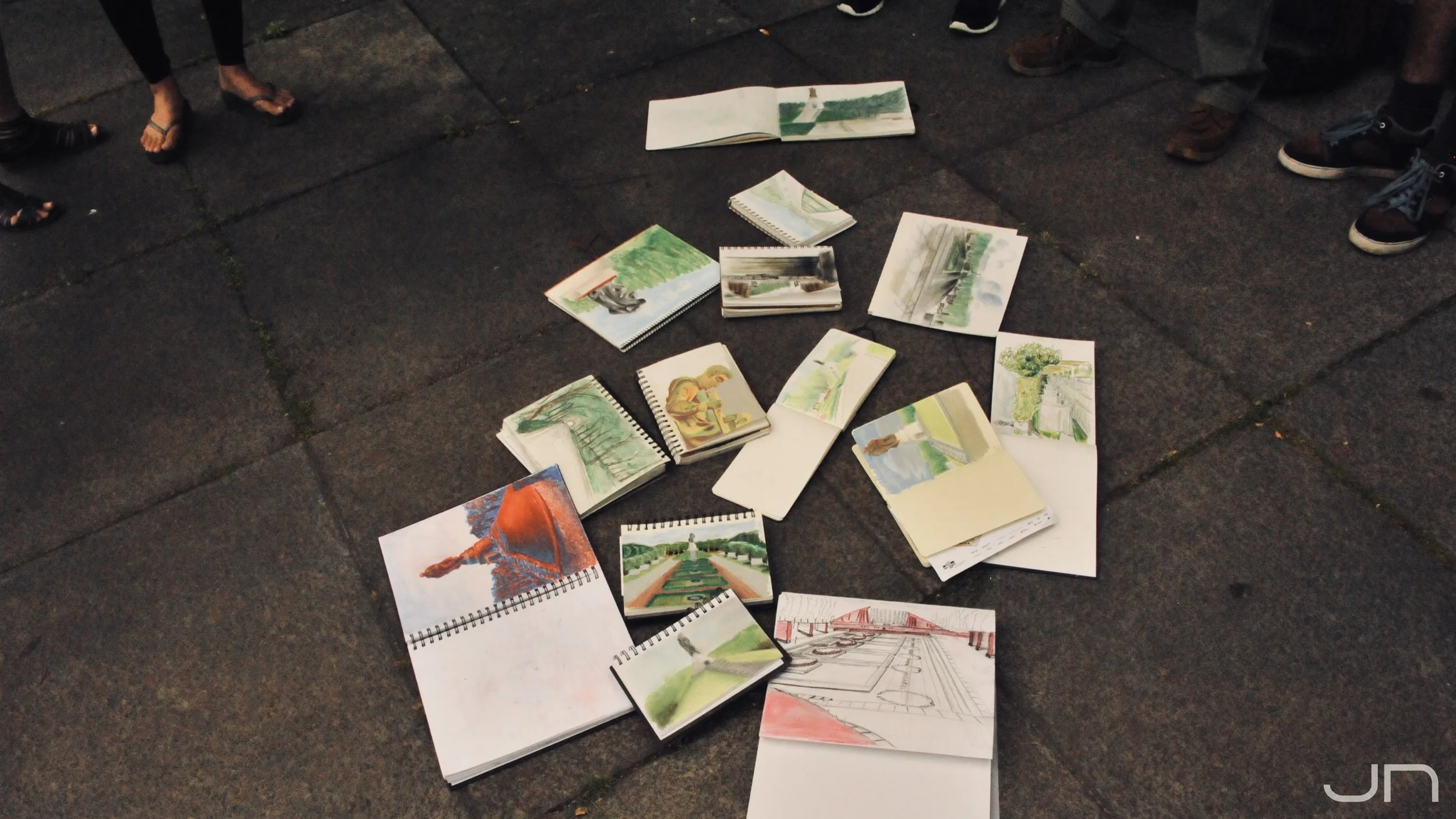
We’d gather in a circle, standing right there on site, and open our sketchbooks for what we called a sketchbook throw-down.
The Throw Down Ritual
The throw down was never a competition — it was a celebration. We’d lay our sketchbooks open so everyone could see: watercolors still damp, pastels and ink lines still smudging if you weren’t careful.
The beauty was in the variety. Twelve people could stand in the same space and come away with twelve completely different interpretations of the same architectural subject. Some sketches were all about precision; others captured atmosphere. A few honed in on details you hadn’t even noticed. It was a reminder that architecture isn’t just about what’s there, it’s about what each person sees.
Why Travel Sketching Matters
Looking back, those 30-minute sessions shaped me as a designer in ways I’m still grateful for. Here’s why I believe travel sketching is a practice worth keeping — whether you’re an architect, artist, or just a curious traveler:
1. It Sharpens Observation
When you’re sketching, you’re not just glancing — you’re studying. You notice lines, edges, proportions, materials and patterns you’d otherwise walk past.
2. It Trains Speed and Confidence
Thirty minutes is just enough time to make decisions but not enough to second-guess every line. You learn to commit and move forward.
3. It Captures Memory Differently
A photograph records what’s in front of you. A sketch records how you experienced it — what you chose to include, what you left out, how the colors felt.
4. It Builds Community
The throw down itself is a shared act. It’s about seeing through each other’s eyes, and realizing how diverse creative vision can be.
From Piazza to Present: Thursday Throw-Downs
Those circles of sketchbooks, held open to the sun, have stayed with me. They’re a tradition I want to bring into my work today — not just for nostalgia, but because I believe the throw down is a powerful way to connect people through creativity.
That’s why I’m building a new ASV community initiative called Thursday Throw-Downs.
The idea is simple:
• Once a week, people across the world will take 30 minutes to sketch — a building, a space, a corner of their own street.
• We’ll share our work together, online or in person, just like we did in the piazzas.
• It’s open to anyone, from seasoned architects to first-time sketchers.
Some weeks, I’ll host online sketch prompts so we can all work on the same theme. Other weeks, I’ll gather a local group for an on-site throw-down, where we can stand in that familiar circle, pages open, seeing what each other saw.
Why Thursday?
Because Thursdays are the perfect almost-weekend energy. Enough time to pause, make something, and connect — and still carry that creative spark into the weekend.
Travel sketching taught me that design is not just about buildings — it’s about perception, patience, and sharing your way of seeing the world. Thursday Throw-Downs will be a space for exactly that: fast lines, fresh perspectives, and a circle of people who understand that the best sketches are never perfect — they’re alive.
Stay tuned or the first Thursday Throw-Down announcement here on Architecture Speaks Volumes. I hope you’ll join me, with your choice of medium in hand.