
THE ASV BLOG
— by JANICE NINAN


PRESERVED IN PROGRESS
WIP Wednesday | The Cathedral that never stops being Built — Preservation Lessons from Cologne’s Kölner Dom.
Some works in progress last a day. Some last a season.
And then there are works in progress that stretch across centuries — becoming living testaments to endurance, craft, and care.
Few buildings embody this better than the Kölner Dom in Cologne, Germany: a Gothic masterpiece that survived the bombings of World War II, outlasted six centuries of construction stops and starts, and continues to be preserved stone by stone even today.
After the war, restoration teams faced a monumental question:
How do you repair a building that took 600 years to build?
The answer became a multi-decade—and now ongoing—project:
shattered tracery rebuilt
stone vaults stitched and anchored
stained glass painstakingly reassembled or redesigned
cracked piers reinforced internally
roofs reconstructed from charred fragments
I knew all of this intellectually before I visited — the Gothic engineering, the war damage, the perpetual restoration — but nothing prepared me for the experience of walking it, touching it, and ascending into its voice.
This is not just a building.
It is a living architectural being — a work in progress that has never stopped evolving, watching, remembering, and speaking.
Walk around the exterior today and you can see the cathedral’s physical memory: areas of lighter, younger sandstone inserted beside centuries-old, soot-darkened originals. Every color shift represents a moment in its repair story.
Architecture as Witness and Memory Keeper
The cathedral’s survival became a symbol of resilience for post-war Germany. Photographs from 1945 show the spires rising above a flattened city — a reminder of endurance when everything else felt lost.
The building is not just architecture.
It is witness.
It is memory.
It is a record of what humanity chooses to preserve, even after destruction.
A STONE Giant That Refused to Fall
Cologne was one of the most heavily bombed cities of WWII. More than 90% of the inner city was destroyed. Yet the cathedral — hit by fourteen bombs, pierced by shrapnel, shaken by shockwaves — remained standing.
Its survival was not luck.
Its survival was design.
The pointed arches, ribbed vaults, flying buttresses, and thick piers formed a skeletal system so resilient that even modern warfare could not collapse it. When the city was flattened around it, the spires rose defiantly above the rubble.
The architecture spoke the only words possible in such devastation:
I am still here.
My experience began in the plaza — a vast stone forecourt alive with thousands of people moving, pausing, circling, meeting, admiring. The cathedral dominates this space not just visually but energetically. Every step feels like entering a gravitational field.
The rhythmic bustle of the crowd contrasts with the stillness of the façade, a stone tapestry stretching impossibly high. The steps leading to the main portal are worn by centuries of feet — pilgrims, tourists, worshippers, students, the curious, the hurried, the lost.
Architecture speaks here through scale, presence, and human movement around it.
Standing at the base of the façade, I felt small in the best possible way — grounded, humbled, welcomed into a story larger than myself.
Inside the Nave — Darkness, Light, and Vertical Silence
Stepping inside, the cathedral’s interior felt like entering a different atmosphere. Cool stone. Soft shadows. Light filtering through stained glass like diffused whispers in color.
But the moment that changed everything wasn’t at floor level.
It was above.
Climbing the Spire — Architecture as Physical Experience
The ascent to the top of the spire is not glamorous. It is physical, narrow, steep, and deliciously disorienting. The spiral staircase coils upward like the inside of a shell. The walls thicken. The air cools. The sound of the plaza fades until there is only breath and stone.
Architecture speaks here through compression — a lesson in how movement shapes emotion.
Reaching the open-air walkways encased in steel mesh felt like stepping into the cathedral’s lungs. Wind rushed through the openings. The city appeared below me in fragments. The stonework — tracery, gargoyles, moldings — revealed itself up close with a level of detail that the plaza could never show.
This is where I truly understood the building as a living organism, perpetually repaired, cleaned, monitored, and honored by the team at the Dombauhütte.
Every lighter stone is a sentence added later.
Every darker stone is an older part of the story.
The Bell Tower — Where Architecture Vibrates
And then came THE BELL!
Seeing the largest bell — St. Peter’s Bell, one of the world’s biggest free-swinging bells — is breathtaking. But hearing it? Feeling the vibration move through the metal grate beneath my feet, through the walls, through my ribs?
That was architectural sound.
Not metaphor.
Not poetic imagery.
Actual sound.
Stone translating vibration into feeling.
Architecture speaking literally.
Looking Down Into the Cathedral
One of the most surreal moments was standing above the nave, looking down into the interior from high above. From this vantage, the ribbed vaults presented themselves like an intricate stone web. People on the ground appeared like moving points of color.
This perspective rewired my understanding of Gothic ambition.
It’s one thing to admire the vaults from below.
It’s entirely another to see how they lock together from above — structure, geometry, light, gravity, all held in exquisite tension.
Preservation as a 700-Year-Long Conversation
Kölner Dom is arguably one of the most continuously maintained structures in Europe. Constantly monitored. Constantly renewed. Its sandstone erodes quickly, turning conservation into a full-time calling.
Its governing body, the Dombauhütte—a medieval-style workshop dedicated solely to the cathedral—still operates today. Stonemasons, glaziers, structural engineers, art historians, and scaffolding specialists work every day — literally every single day — to keep the building alive.
This is where the philosophy crystallizes:
Architecture that speaks volumes cannot ever be “finished.”
Its voice is shaped by:
war scars
pollution stains
newly cut stones
medieval carving traditions
contemporary engineering
weathering
human hands
time
The building evolves, and that evolution becomes its message.
What the Kölner Dom Taught Me About How Architecture Speaks
Walking the plaza…
Climbing the stairs…
Standing beside the bells…
Looking down into the nave…
Watching sunlight move across stone…
All of it converged into a single lesson:
Architecture speaks through endurance, presence, and lived experience.
It is not frozen.
It is not silent.
It is actively communicating — if we take the time to listen.
The Kölner Dom speaks volumes about:
resilience
craftsmanship
continuity
memory
community
faith (in both the spiritual and architectural sense)
the long arc of human effort
And most importantly:
that some works in progress are meant to last forever.
A Final Thought: The Cathedral as a Living Conversation
As I descended back to the plaza, reentering the movement of the crowds, I realized something profound:
Every person who touches this cathedral becomes part of its ongoing story.
Every stone replaced continues the dialogue.
Every footstep on the plaza acknowledges its presence.
Every preservation effort is an act of care, not completion.
The Kölner Dom does not ask to be admired.
It asks to be understood.
And through its walls, its scars, its bells, its views, and its never-ending restoration, it reminds us — especially those of us who design — that architecture speaks volumes when it is allowed to live, adapt, and endure.
Why This Matters for Designers Today
In our contemporary world of fast timelines and faster demolitions, Kölner Dom challenges us to rethink what “preservation” means:
What does it look like to design for centuries, not decades?
How do we plan materials that can be repaired, replaced, and honored over time?
What does stewardship mean in an era obsessed with speed?
How do we let a building age authentically, while protecting it from irreversible loss?
Preservation isn’t about freezing a building in time.
It’s about allowing it to change—carefully, deliberately, respectfully.
Kölner Dom is a masterclass in this mindset.
A reminder that architecture isn’t a final product.
It’s a relationship.
And some relationships are meant to last forever.
The Art of the ‘Throw-Down’
Studio Saturdays | Building community one sketch at a time.
There’s a certain kind of magic in sketching on location — the kind you can’t replicate in the studio, no matter how sharp your pencil or how big your desk.
I first felt it during my study abroad program in Europe. Our professor, John DeSalvo, would take us to a piazza, a cathedral square, or a tucked-away alley framed by centuries-old stone. The instructions were simple:
“Here’s the architectural subject.
Pick your spot.
You have 30 minutes.
Go.”
We’d scatter — some gravitating toward the front steps of a church, others to the cool shadow of a colonnade or a cafe bench beneath a tree. We had half an hour to capture the subject given, to draw whatever caught our eye: the physical or ephemeral; the macro or micro.
When time was up, the real magic happened.
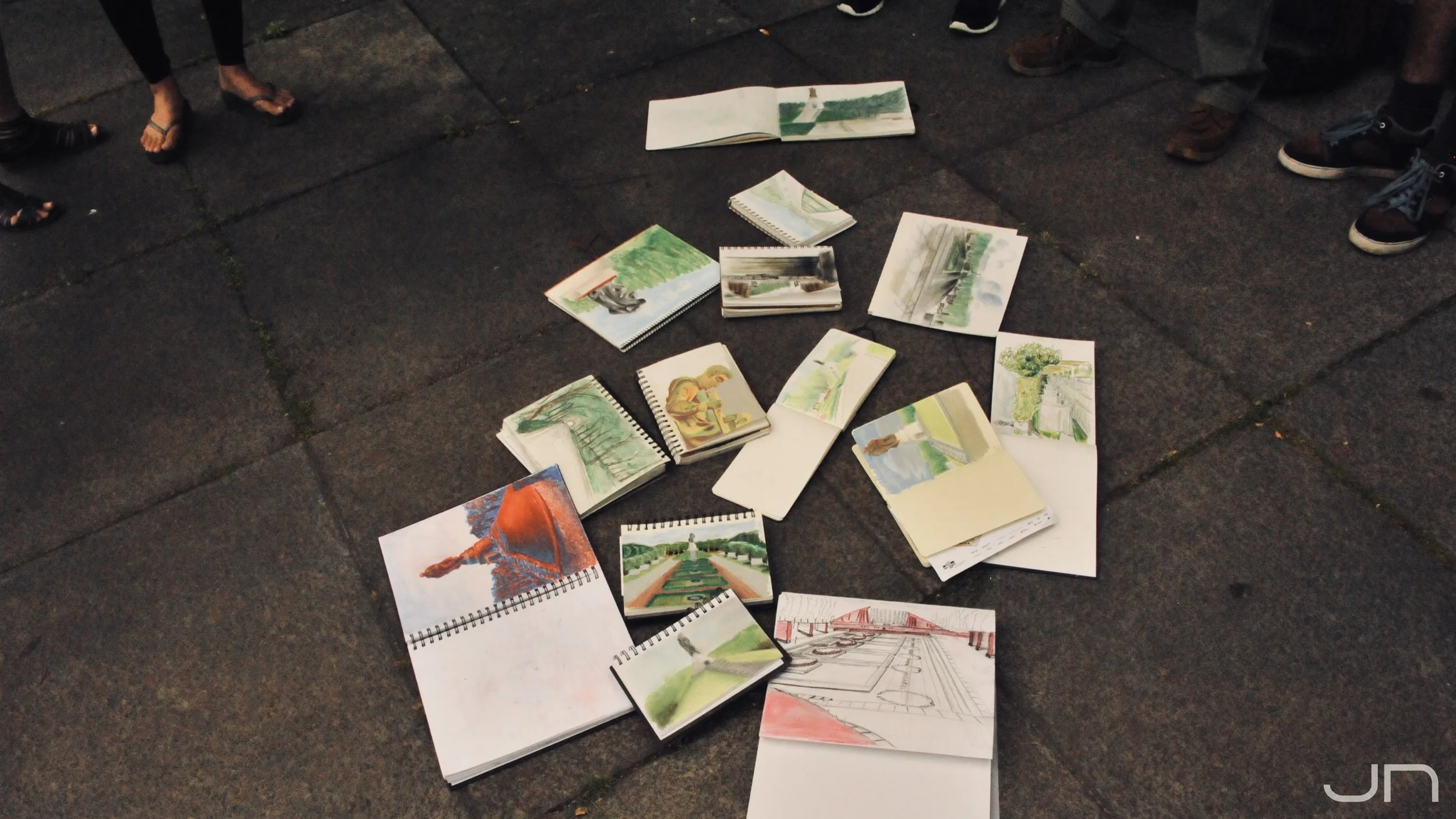
We’d gather in a circle, standing right there on site, and open our sketchbooks for what we called a sketchbook throw-down.
The Throw Down Ritual
The throw down was never a competition — it was a celebration. We’d lay our sketchbooks open so everyone could see: watercolors still damp, pastels and ink lines still smudging if you weren’t careful.
The beauty was in the variety. Twelve people could stand in the same space and come away with twelve completely different interpretations of the same architectural subject. Some sketches were all about precision; others captured atmosphere. A few honed in on details you hadn’t even noticed. It was a reminder that architecture isn’t just about what’s there, it’s about what each person sees.
Why Travel Sketching Matters
Looking back, those 30-minute sessions shaped me as a designer in ways I’m still grateful for. Here’s why I believe travel sketching is a practice worth keeping — whether you’re an architect, artist, or just a curious traveler:
1. It Sharpens Observation
When you’re sketching, you’re not just glancing — you’re studying. You notice lines, edges, proportions, materials and patterns you’d otherwise walk past.
2. It Trains Speed and Confidence
Thirty minutes is just enough time to make decisions but not enough to second-guess every line. You learn to commit and move forward.
3. It Captures Memory Differently
A photograph records what’s in front of you. A sketch records how you experienced it — what you chose to include, what you left out, how the colors felt.
4. It Builds Community
The throw down itself is a shared act. It’s about seeing through each other’s eyes, and realizing how diverse creative vision can be.
From Piazza to Present: Thursday Throw-Downs
Those circles of sketchbooks, held open to the sun, have stayed with me. They’re a tradition I want to bring into my work today — not just for nostalgia, but because I believe the throw down is a powerful way to connect people through creativity.
That’s why I’m building a new ASV community initiative called Thursday Throw-Downs.
The idea is simple:
• Once a week, people across the world will take 30 minutes to sketch — a building, a space, a corner of their own street.
• We’ll share our work together, online or in person, just like we did in the piazzas.
• It’s open to anyone, from seasoned architects to first-time sketchers.
Some weeks, I’ll host online sketch prompts so we can all work on the same theme. Other weeks, I’ll gather a local group for an on-site throw-down, where we can stand in that familiar circle, pages open, seeing what each other saw.
Why Thursday?
Because Thursdays are the perfect almost-weekend energy. Enough time to pause, make something, and connect — and still carry that creative spark into the weekend.
Travel sketching taught me that design is not just about buildings — it’s about perception, patience, and sharing your way of seeing the world. Thursday Throw-Downs will be a space for exactly that: fast lines, fresh perspectives, and a circle of people who understand that the best sketches are never perfect — they’re alive.
Stay tuned or the first Thursday Throw-Down announcement here on Architecture Speaks Volumes. I hope you’ll join me, with your choice of medium in hand.