
THE ASV BLOG
— by JANICE NINAN
ARCHITECTURE WITHOUT CONSENT
Mark Mondays | When the form of THE White House is not the form of democratic process.
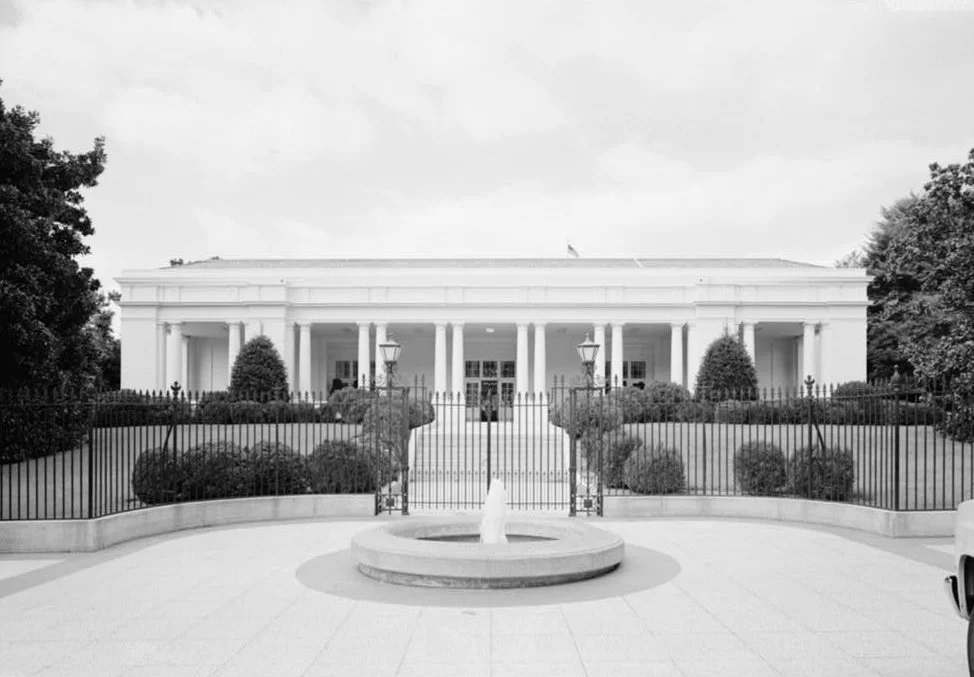
Every first Monday of a month, I look at the marks architecture leaves behind — sometimes through what is built, sometimes through what is lost. This week’s mark is one of absence. The East Wing of the White House — a space steeped in history, ceremony, and civic symbolism — has been erased. What eventually rises in its place will not just be a new gilded ballroom, but a new question: what happens when architecture moves forward without democratic consent?
The Mark of Erasure
The White House has never been static. It has burned, been rebuilt, expanded, reinforced, and reimagined over two centuries — each transformation leaving its own architectural signature. Yet the recent demolition of its East Wing and the proposed privately funded ballroom rising in its place mark a rupture, not a continuation.
This is the mark of erasure — a physical void where a historic structure once stood, and a conceptual one where public voice has fallen silent. The East Wing was more than service corridors and offices; it was the connective tissue between the ceremonial and the domestic, the public and the private. To remove it without conversation is to edit history without annotation.
The Mark of Omission
For the first time in the modern era, a significant alteration to the architecture of the People’s House has proceeded without visible public or professional engagement. There were no open design discussions, no advisory reviews from the Committee for the Preservation of the White House, no national dialogue about what this change represents. The process unfolded quietly, swiftly, and underwritten by private wealth.
This absence is its own kind of mark — the mark of omission. The silence around this project speaks volumes about a shift in how power operates: architecture once used to symbolize democracy is now deployed to bypass it.
The Mark of Power
Architecture is never neutral. It encodes hierarchy, ideology, and values into form. When a building as symbolic as the White House changes shape, the act reverberates far beyond its walls. The East Wing’s demolition is not merely a spatial alteration — it is a statement about governance and authority: who holds the right to alter a national symbol, and whose vision that change serves.
Throughout history, even the most drastic White House renovations — from Truman’s total interior reconstruction to Roosevelt’s creation of the West Wing — involved architects, historians, preservationists, and public oversight. They were changes made through process, however imperfect. What distinguishes this moment is not the scale of construction but the erosion of transparency — the mark of power overtaking process.
The Mark of Patronage
The proposed ballroom, reportedly funded by wealthy businessmen, compounds the unease. Public architecture derives legitimacy from public trust. When a national monument is reshaped by private money, it shifts from civic representation to personal projection. The funding itself leaves the mark of patronage — a return to an older, pre-democratic model of building, when architecture served donors rather than citizens.
The White House, long an emblem of the collective, risks becoming an estate of the few. The very space meant to host the public narrative may soon echo with private applause.
The Mark of Memory
And then there is what remains — memory. Architecture is temporal; every renovation overwrites another, layering time into space. But when change comes without consent, memory becomes resistance. Photographs, drawings, and stories of the East Wing now hold what the structure no longer can: evidence of a public ethos. The mark of memory is fragile, yet it endures — a quiet archive of what once stood for inclusion, transparency, and civic participation.
The Mark This Monday Leaves
Architecture speaks in silences as much as in structures. When the conversation between government, architects, and citizens is muted, design stops being democratic — it becomes declarative. The mark this Monday leaves is a reminder that architecture, like democracy, depends on participation.
When we stop being invited into the process, we are no longer represented in the result.
And the White House — the most visible house of the people — can only remain so if it continues to bear the mark of our collective voice.
Blogpost Cover Image Credit - East Wing; view of East Elevation, circa 1985–1992 - Library of Congress, Prints & Photographs Division, DC,WASH,134-207
Concrete, Stilled: Tactile Encounters at the Pulitzer Foundation
Tactile Tuesdays | The Atelier Diaries
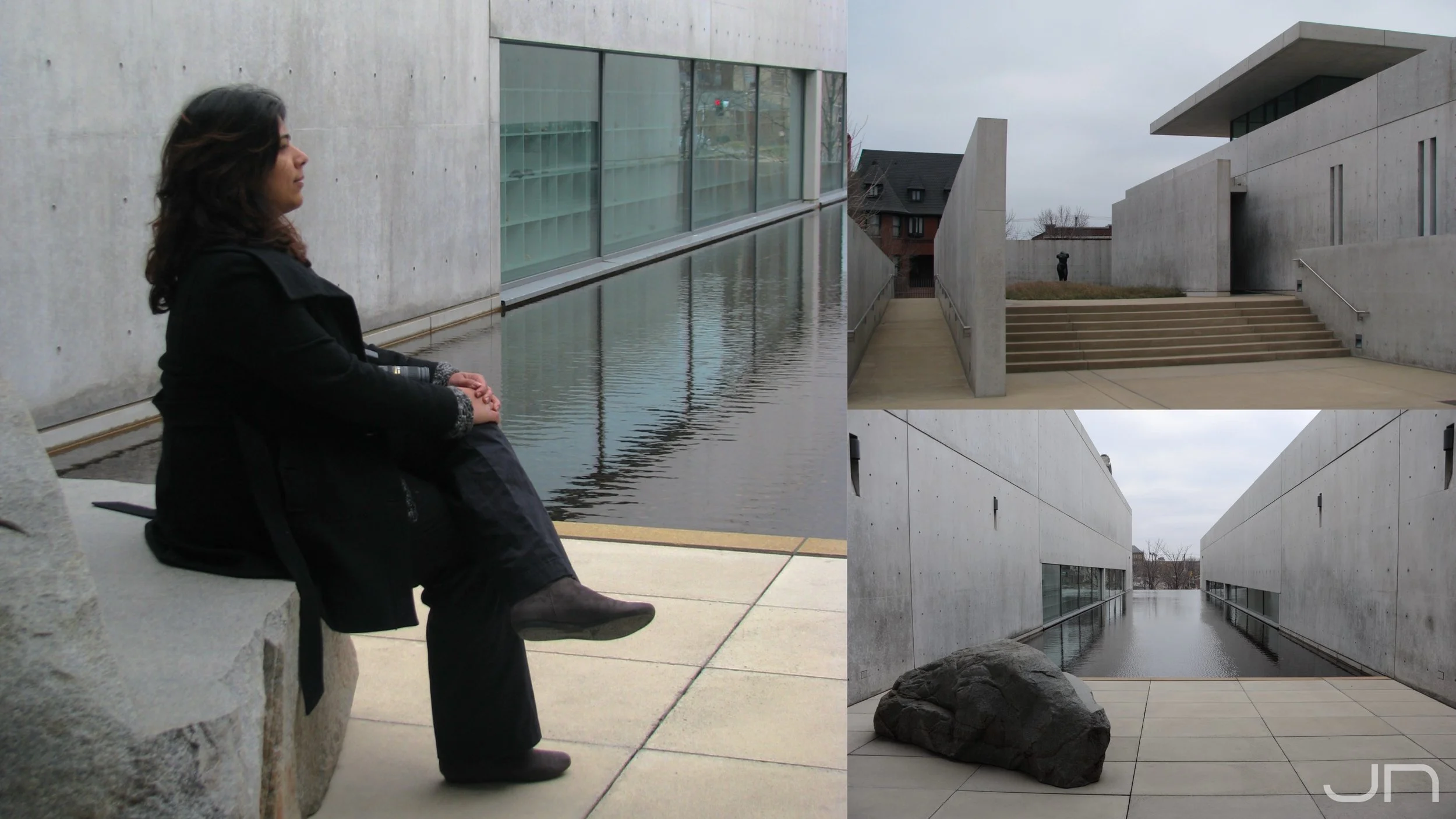
There are buildings that impress, and then there are buildings that quiet you. The Pulitzer Foundation for the Arts in St. Louis — designed by Tadao Ando — is the latter. I visited it not for spectacle, but for stillness. Ando gave me both.
The architecture doesn’t scream. It breathes. And its primary language is concrete.
The Weight of Silence
The moment I stepped inside, the world slowed. What struck me first wasn’t the form or function — it was the weight of the quiet. Ando’s concrete isn’t brutish or cold. It’s monastic. Still. Thoughtful.
Each ply-formed surface reads like a fossilized imprint of craft — a record of time, pressure, labor, and intention. The material holds memory in its grain. It receives light in a way that feels deeply human.
Concrete as Skin
This isn’t the concrete of parking garages and freeways. This is concrete made tactile — not to be touched, but to touch you.
In the Pulitzer’s galleries and corridors, the concrete walls glow under filtered daylight, their surfaces softened by shadow. The edges are precise, but the experience is sensory. I didn’t just see the concrete. I felt it in the way it held space.
It reminded me that materiality is not just a question of aesthetics or durability — it’s an emotional register. A medium of mood.
A Material Lesson
As a designer, I’m always looking for how materials speak. At the Pulitzer, the concrete didn’t shout. It whispered. It invited stillness. Reflection. Reverence.
Ando’s approach reaffirmed something I return to again and again in my own work: the power of restraint. That space doesn’t always need to explain itself. Sometimes, it just needs to hold you — gently, firmly, silently.
Closing Reflection
Tactile Tuesday is about more than surface. It’s about experience. And this one stayed with me.
“You don’t touch the concrete — not literally. But it touches you.”
— Architecture Speaks Volumes
Have you visited a space that made you feel something — not for how it looked, but how it held you? I’d love to hear.
Leave me a comment on instagram → @architecturespeaksvolumes
Atelier DIARIES 001 - THE FIRST MARK
Mark Mondays | A quiet beginning. A rhythm set in motion.
A line on paper can hold weight — the suggestion of a wall, a threshold, a beginning.
This diary begins with such a line.
A Practice of Noticing
Atelier Diaries is my monthly ritual — a week of creative entries shared from inside my studio, beginning on the first Monday of every month.
Seven days. Seven creative gestures.
Each one a way of noticing what surrounds me — and what moves through me — in the act of making.
It’s a way of shaping my creative practice.
A rhythm I can return to.
A living record of my process — marks, materials, memories, meanings.
Why I Started This
We live with a constant need for speed.
Fast content, fast commentary, fast consumption.
But architecture — and creativity — aren’t built that way.
They need stillness.
They need time.
So I made a structure to hold that time.
A scaffold for attention.
Atelier Diaries is how I remember to slow down.
To shape, not just produce.
To process, not just present.
The Shape of the Week
Each month, beginning on the first Monday, I post seven entries — one per day. Each post builds on the facets of a creative practice :
• Mark Monday — gesture marks a beginning
• Tactile Tuesday — the body of memory
• WIP Wednesday — process over polish
• Threshold Thursday — liminal moments
• Feature Friday — finding a voice
• Studio Saturday — the work behind the work
• Story Sunday — the quest for meaning
Together, these entries become a visual zine of sorts.
A sketchbook.
A diary in blueprint.
Atelier Diaries 001: The first mark.
The first issue is an invitation.
A soft landing.
A pause before movement.
I don’t expect this series to explain anything. Only to offer a way of looking — and being — a quiet glimpse into my creative process.
Atelier Diaries is not chronological. Its intuitive.
This first mark is both literal and symbolic.
A gesture toward a slower practice.
This diary is how I strive to stay connected to the core of my work —
the part that doesn’t rush.
The part that listens.
If you are curious - Join the Rhythm
View the full series on Instagram → @architecturespeaksvolumes
Or subscribe to my newsletter receive a new studio diary each month.
A new diary begins the first Monday of every month.
I hope you’ll follow along or return to the diary when you need a slower moment.
Until then, I leave you with this:
Which day of the week speaks to you this month?
I’d love to know.
Leave me a comment on instagram → @architecturespeaksvolumes
Architecture Speaks Volumes
August 2025